Evidence of bird strike on plane where man was nearly sucked out window, NTSB says
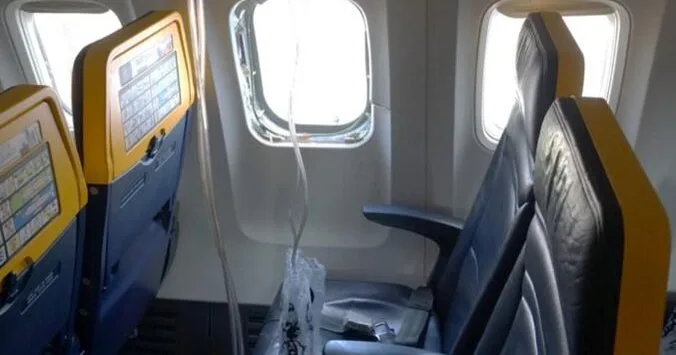
A bird strike may have been the cause of an incident in which a passenger was nearly sucked out of a broken window aboard a Ryanair flight in Europe last month, the U.S. National Transportation Safety Board said in its preliminary report Thursday.
According to the NTSB, on the morning of July 10, the No. 2 engine of Ryanair Flight 1879, a Boeing 737, experienced a failure just minutes after takeoff from Thessaloniki, Greece, as it was bound for Memmingen, Germany.
One of the engine's fan blades broke off, according to the report, sending debris out of the engine, which sliced into the fuselage of the plane at several points, the NTSB determined, damaging the aircraft as well as busting out a passenger window in row 11.
The passenger sitting in that seat was partially sucked out of the plane, suffering serious injuries, the NTSB said.
NTSB investigators discovered evidence of bird remains, including feathers, inside the engine that failed. Pilots received a warning about the engine and then heard a loud bang, the report said.
"Engine fragments breached the fuselage and the cabin depressurized," the NTSB report stated.
Pieces of the shattered window were found across several rows of the plane, the NTSB said. Investigators also found signs of metal fatigue at the base of the fan blade that broke off, despite recent inspections of the fan blades. Three loose fan blade fragments were recovered from the engine.
Data recorders revealed that the vibrations on the No. 2 engine were higher than those of the No. 1 engine during the end of takeoff, the NTSB said.
NTSB investigators also found that engine updates that have been required for U.S. airlines to complete by 2028 have not been made on this aircraft. As Ryanair is an Irish airline, it is not subject to Federal Aviation Administration regulations.
There were 149 passengers and six crew members aboard the plane, which immediately returned to the Thessaloniki International Airport, the NTSB said. No one else aboard was hurt.
The plane had been involved in four reported bird strikes in the previous 12 months leading up to the July 10 incident, according to the NTSB, and bird remains were previously found in two of those cases.
NTSB investigators said the latest bird remains they found were deep inside the engine, and they're unsure if they were from the July 10 incident or from something previous.
Those remains and other samples were sent to the Smithsonian Institution Feather Identification Lab in Washington, D.C., for examination.
The injured passenger, a 61-year-old Serbian man, later recounted his experience to The Guardian.
5News aggregated this summary from the outlet’s public feed. The full article, with all the context, is on www.cbsnews.com — the content belongs to CBS News.