The one thing you can do to help a whole lot of animals, explained in 4 charts
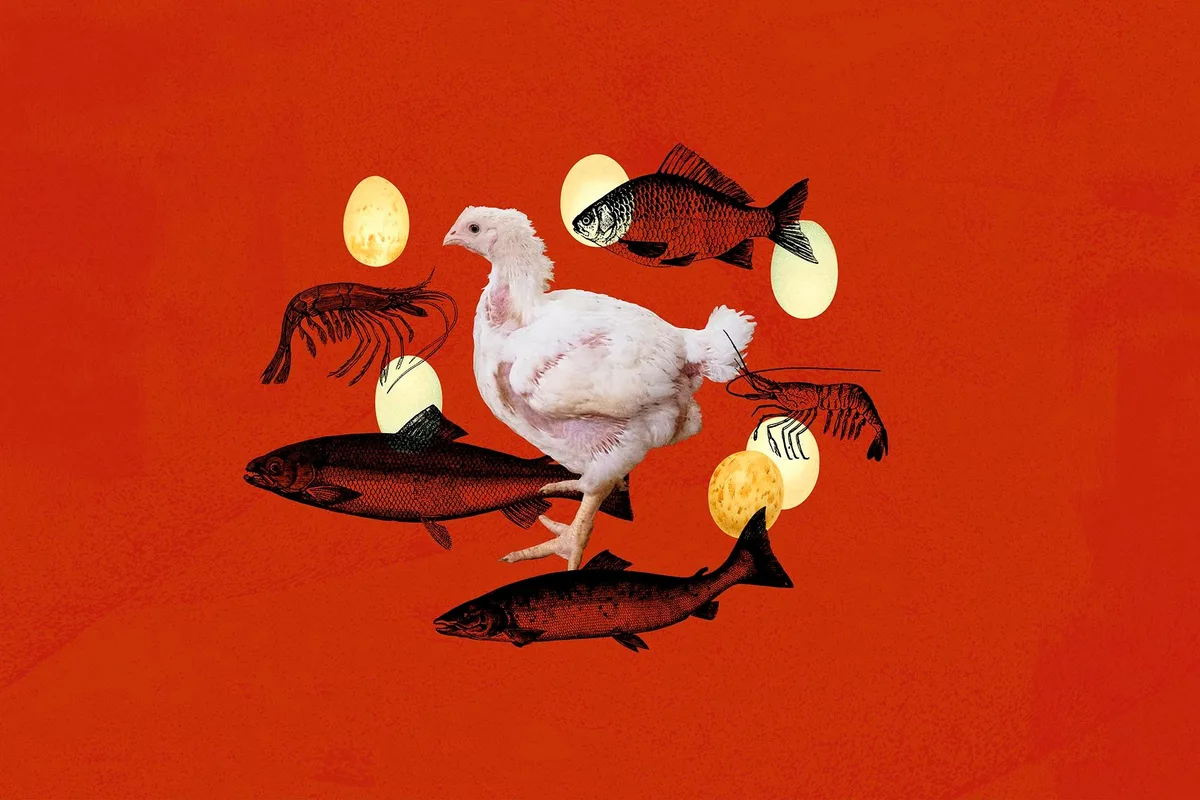
Many people, when they learn about the horrors of factory farming , become vegetarian or vegan.
I’m one of those people, and it stuck — I haven’t eaten meat in 20 years.
For most, it doesn’t stick .
But new research highlights how ditching meat isn’t the only option to help animals on factory farms.
There’s actually one thing that’s almost as effective and probably way easier for most people: eating fewer small animals.
The number of animals who suffer to produce food products — and how much they suffer — varies widely.
Bigger animals, like cattle raised for beef, are raised in lower numbers and aren’t treated as terribly as smaller animals, like farmed fish and chickens.
And because fish and chickens are so small, far more of them must be farmed to produce the same amount of meat as large animals.
A family sitting down for a steak dinner, for example, will probably consume about half a percent of one cow, while a family eating a rotisserie chicken might eat the whole bird.
Animal advocates call it the “small body problem,” and it’s the subject of a new analysis published by Chris Bryant , an honorary research associate at the University of Bath in the UK, and Faunalytics , an animal welfare research group.
The researchers wanted to answer a simple but consequential question: How much animal suffering is embedded in each bite of meat we eat or egg we consume? “We are somewhat used to seeing, especially from the climate movement, data and other kinds of tools that help us think about the carbon footprint of the choices that we make, and we think that’s really important,” Allison Troy, Faunalytics’ research director, told me.
“But we felt like there was a gap in terms of thinking about more of a ‘suffering footprint’ when it comes to choosing to purchase animal products.” This gives us a new way to think about how we eat, and how it affects the animals trapped in factory farms.
If you don’t want to go fully plant-based, what about cutting back — specifically — on meat from small animals? Unpacking the small body problem To quantify the “suffering footprint” of everyday animal products consumers eat, the researchers analyzed data from the US Department of Agriculture, the United Nations, and other sources to determine how much edible meat — or eggs or milk — each type of farmed animal produces throughout a typical lifespan on a farm.
They also incorporated indirect sources of animal suffering in their calculations.
5News aggregated this summary from the outlet’s public feed. The full article, with all the context, is on www.vox.com — the content belongs to Vox.