Transcript: Neel Kashkari, Minneapolis Fed president and CEO, on "Face the Nation with Margaret Brennan," Aug. 23, 2026
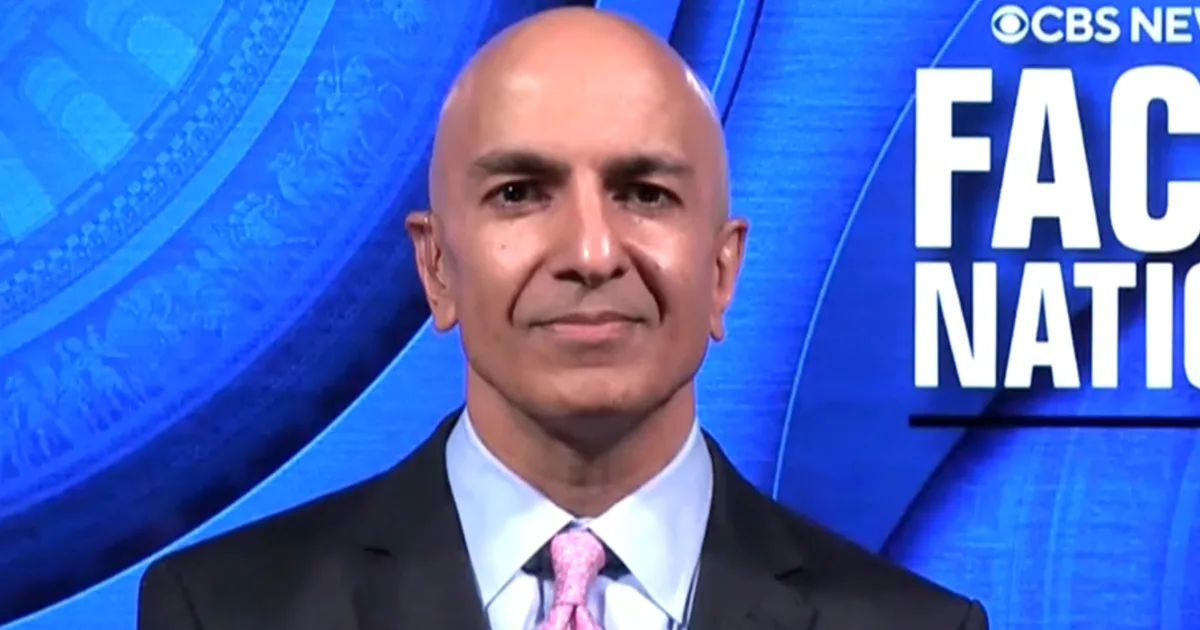
The following is the transcript of an interview with Neel Kashkari, President and CEO of the Federal Reserve Bank of Minneapolis that aired on "Face the Nation with Margaret Brennan" on Aug. 23, 2026.
MARGARET BRENNAN: For more on what's next for the American economy, we're joined by Neel Kashkari, President and CEO of the Federal Reserve Bank of Minneapolis. Welcome back to Face the Nation.
MARGARET BRENNAN: So when we spoke back in May, I asked you about the debt level America has. You said you didn't see an immediate crisis brewing, but at some point, this is going to become a problem. We just hit $40 trillion. Are we at the point where this is a problem?
: Well, Margaret, if you look at the Treasury yields, yields are high, 4.7% for example, on the 10-year Treasury. They're high relative to recent history. They're not high relative to more longer American history. In the early 2000s, the 10-year Treasury and the 30-year Treasury were around these levels. In the 90s, they were meaningfully higher than they are now, and there's no sign of Treasury market dysfunction or breaking down in financial markets. There are a lot of different factors that go into those Treasury yields. Inflation, and the outlook for inflation is one of those factors, that's the Fed's job. But there are many other factors, like, it's the AI investment, government borrowing, economic growth. All of those end up going together to set these long-run Treasury yields.
MARGARET BRENNAN: But we saw this bond sell-off. We saw extraordinary action by the Treasury Secretary Scott Bessent to intervene. He said what was happening was due to traders having bad information. Is that what's happening?
: Well, I'm going to leave it to the Treasury Secretary to manage the Treasury debt market. That's the job of the Treasury Department. The Fed's job is really to take care of the inflation piece of it. We are all absolutely committed to getting inflation back down to 2%, but long run, it's going to be fundamentals of debt issuance, of investment, of economic growth and productivity. Long run, that's what sets the Treasury yields, and not just in the U.S. but government bond yields all around the world.
MARGARET BRENNAN: No, and I appreciate as a central banker, you don't want to get involved in fiscal policy or what the markets are doing day to day, but there is this debate right now about whether something more fundamental is shifting. Investor Mohamed El-Erian wrote in the New York Times, "There's a breathtaking leap in the cost of borrowing. If it persists, it could mark the beginning of a structural economic shift more enduring and more globally consequential than most previous episodes of market volatility." Is that overstating things? Are we in the midst of a huge shift?
: Well, there are a lot of different factors going on at the same time. So, the stock market, as you know, has been really bullish for the last several years, really excited about AI and the prospects that that will lead to productivity growth.
5News aggregated this summary from the outlet’s public feed. The full article, with all the context, is on www.cbsnews.com — the content belongs to CBS News.