This widdle biddy baby world is breaking planet formation theories
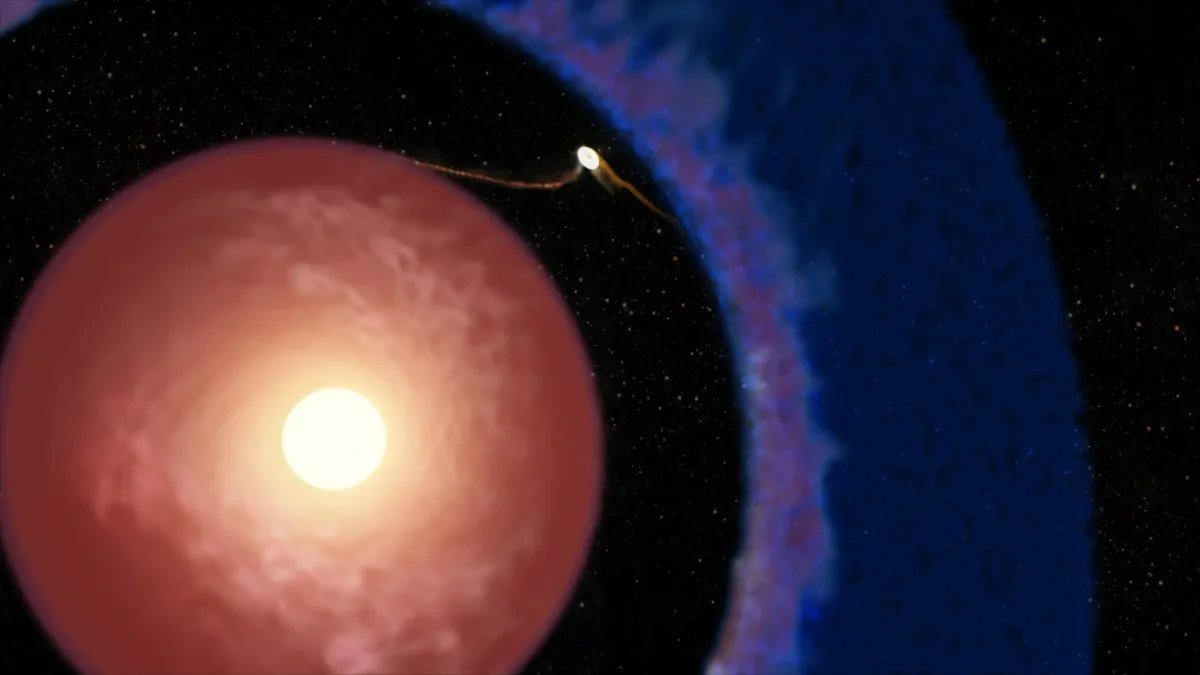
Exoplanet hunters scouring space for worlds around other stars have found the youngest planet on record.
This Jupiter-size planet, about 450 light-years away from Earth, is less than 1 million years old.
That's much younger than the previous record holders — four worlds tied at about 5 million years old each.
Astronomers confirmed this detection by reviewing NASA -funded archives from the W.M.
Keck Observatory's coronagraph , an instrument that blocks a star's light to reveal faint objects hiding in its glare.
When they looked at the Hawaiian telescope's observations from 2018 and 2020, they saw what two other major observatories had already spotted: a baby, still snuggled up in its nest of gas, dust, rock, and icy bits.
The world is called Elias 2-24 b.
"The galaxy churns out new stars and planets continuously," said Lucas Cieza, a professor at the Instituto de Estudios Astrofísicos in Chile, in a statement , "but there is a large gap in what most telescopes can detect.
We are mostly blind to these baby planets right now." SEE ALSO: Scientists say if Venus ever had a moon like ours, it was doomed Researchers went back to the archives because of some unsettled business.
Two major Chilean telescopes, the Atacama Large Millimeter/submillimeter Array and the European Southern Observatory's Very Large Telescope, had seen what looked like an empty ring of space around the distant Elias 2-24 star, along with a faint point of light in that "empty" band.
When those observations occurred a decade ago, astronomers were doubtful.
Leading planet-formation theories estimate that it takes about 5 million years to make a Jupiter-size planet, and even longer for worlds farther out from their stars.
Elias 2-24 b defies those predictions, orbiting its star 10 times farther than Jupiter circles the sun .
An ALMA observatory radio image of Elias 2-24, a young star surrounded by dust and gas that might be forming stars, taken in 2016.
5News aggregated this summary from the outlet’s public feed. The full article, with all the context, is on mashable.com — the content belongs to Mashable.