The Secrets Buried Beneath the Sands of Key West
Editor’s note: This story is part of a special series by Princeton University journalism students reporting on the discovery of an African burial ground in Key West , Florida, and how the legacy of slavery still reverberates through the island community and beyond.
O n June 14, 2002, Dr. Corey Malcom and a small team of researchers headed out to an area of Higgs Beach, a 16-plus-acre parcel of land on the southernmost shore of Key West, Florida, with a ground-penetrating radar detector. Malcom, a historian and director of archaeology at the island’s Mel Fisher Maritime Museum, was searching for unmarked graves he believed were underfoot. He had recently come across records that dated back to 1860, documenting the burials of 295 Africans who’d been rescued from Cuba-bound slave ships by the U.S. Navy and perished on Key West’s shores, having fallen ill at sea. If the GPR detector’s radio waves bounced off an object deep underground, a unique hyperbolic reflection would appear on a screen attached to the small push mower-like machine.
“We started getting parabolas again and again and again through here,” Malcom says, gesturing with his hands across the space on a warm day last March. “We took the data, processed it, and found in this zone right here 15 graves lined up, more or less in three rows, all side by side. And it was exactly where the 1861 map said they would be.”
The discovery was only the beginning of Malcom’s years-long effort to uncover and properly commemorate the truth of what happened on that stretch of sand more than 140 years ago. “We know, OK, there’s still people missing,” Malcom says, reflecting on his reaction to the early findings. “We’ve got 15 graves; there’s 295 people that died. Where are they?”
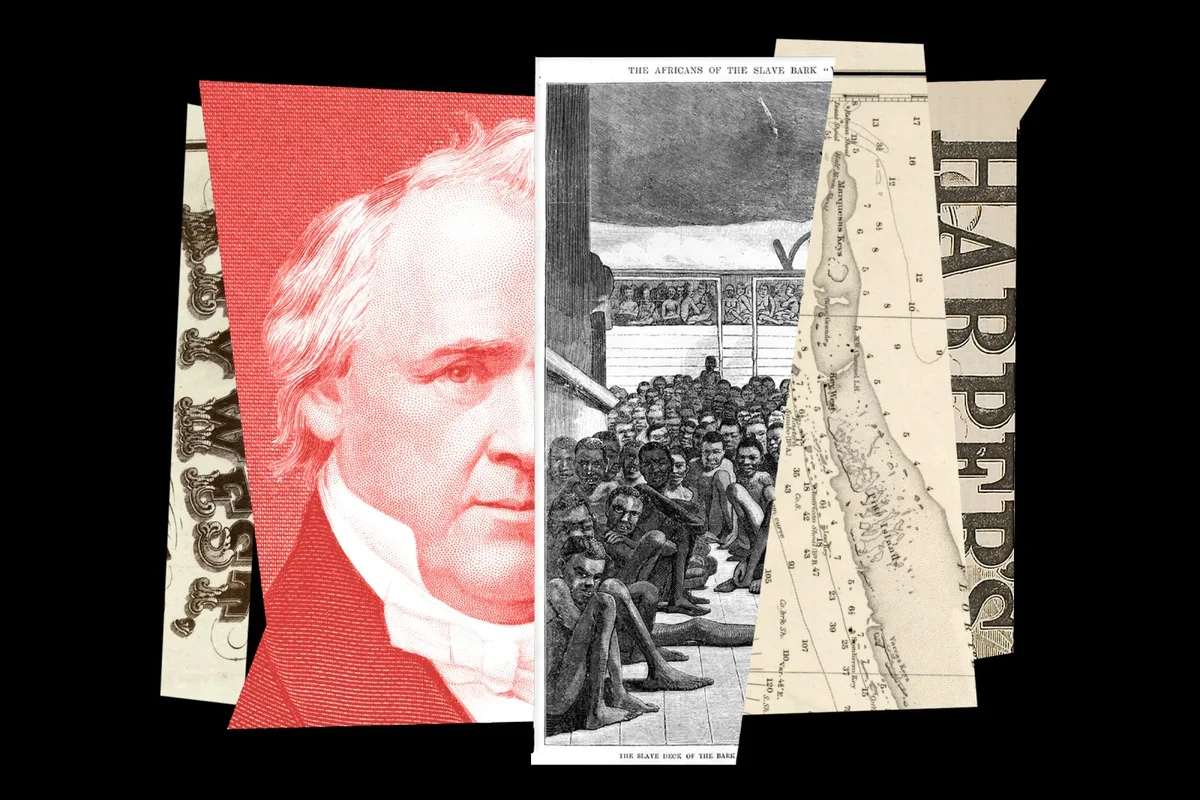
THE U.S. OUTLAWED the Transatlantic Slave Trade in 1808. Nonetheless, some American slavers continued the trade illegally, bringing kidnapped Africans to Cuba and other places outside of the United States, often hiding their ships under the Spanish flag. By 1859, the U.S. Navy had already been fighting the illegal slave trade for years, with little to no impact. But the addition of three steamships to its patrol fleet, which could maintain 10.5 knots, or 12 miles per hour, brought success. The steamers captured six slaver ships in 1860 alone. Three of those ships — the Wildfire , William , and Bogota — were towed to the closest American land: Key West. The 1,432 Africans on board, many of them sick upon arrival, were to be housed there temporarily until they could be returned to Western Africa.
Hundreds of Africans were on board the Wildfire when the USS Mohawk intercepted the ship off the coast of Cuba on April 26, 1860. Upon boarding the slave ship, Lieutenant Tunis Craven, the Mohawk ’s 47-year-old captain, found 510 Africans “packed below in as dense a mass as it is possible for human beings to be crowded,” according to a letter he wrote to U.S. Secretary of the Navy Isaac Toucey later that year. At some point during the journey to land, the 450-odd men and boys on board were brought up on deck and sat huddled together with their heads resting on their bent knees.
5News aggregated this summary from the outlet’s public feed. The full article, with all the context, is on www.rollingstone.com — the content belongs to Rolling Stone.