Mom-to-be had 2 signs of rare complication: "Everything kept getting worse"
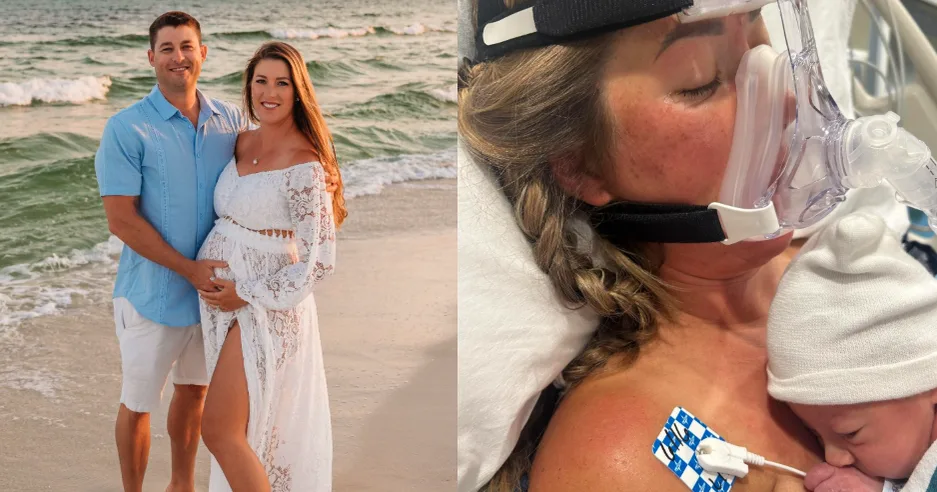
Candice Davis had been pleasantly surprised by the ease of her first pregnancy. Her checkups were always clear, and she had few symptoms — until June 14, 2025, 11 days before her due date.
The day started normally, but as the hours passed, Davis began to feel nauseous while sitting by her pool. Eventually, it shifted to upper abdominal pain. Her husband was insistent that she go to the hospital. Davis resisted at first. She worked as a recruiter for an OB-GYN, and felt she would know if something was seriously wrong. But when her friend and OB-GYN Dr. Susan Passarella also urged her to go to the ER, she gave in.
At the obstetric emergency department at Baptist Hospital in Pensacola, Florida , tests showed Davis' blood pressure was elevated. Her doctors decided to keep her overnight. Then things escalated quickly.
Davis' pain increased sharply. Her blood pressure kept rising. Her liver enzymes skyrocketed. Within two hours of her arrival, her care team wanted to induce labor. Davis had hoped to have a natural birth. But "everything kept getting worse," she said, and the decision was made to deliver her baby via cesarean section.
"And thank goodness we did," Davis said. "I was in a lot of pain. They ended up giving me an epidural to help with the pain in the upper abdomen, which did not even touch it. I just remember I was scared. I physically knew that I could not birth my son naturally. I couldn't even sit up. I was scared, but there was just so much going on."
Davis was experiencing HELLP syndrome, a rare pregnancy condition that is related to preeclampsia . It affects the liver and can cause rapid bleeding. While preeclampsia occurs in about 5% to 8% of pregnancies, only about 0.01% to 0.06% of cases develop into HELLP syndrome, Passarella said. Typically, patients recover from the condition after delivering.
Davis' son was safely delivered via C-section, but it turned out his body had been putting pressure on a 17-centimeter injury in her liver. When he was delivered, the organ started to bleed — and didn't stop.
"When they were getting my son out, they said, 'Oh, there's not blood. This is good,'" Davis said. "And within seconds, it was, 'Oh, there's blood, there's a lot of blood.' The anesthesiologist came in and put a mask over my face, and said, 'OK, we've got to put you out now.'"
Davis' team had been prepared for this outcome because of her elevated liver enzymes. A surgeon was on hand, and the C-section had been performed in such a way that surgeons could reach her liver if necessary.
But the bleeding wouldn't stop. Davis became too unstable for further surgery, forcing doctors to pack her body with sterile materials and wait overnight for her to regain some strength. She couldn't breathe on her own. Passarella, who was receiving updates through Davis' husband, feared her friend would never wake up.
"It was just one thing after another," said Passarella, who has treated patients with HELLP syndrome. "He asked me, 'Is she going to survive this?' I didn't know what was going to happen."
After about 24 hours, doctors were able to stop Davis' bleeding.
5News aggregated this summary from the outlet’s public feed. The full article, with all the context, is on www.cbsnews.com — the content belongs to CBS News.