Trump’s border wall construction threatens rock art as old as the pyramids: ‘The ancestors are still here’
The president’s border wall plan could damage or destroy ‘the oldest-known books in North America’
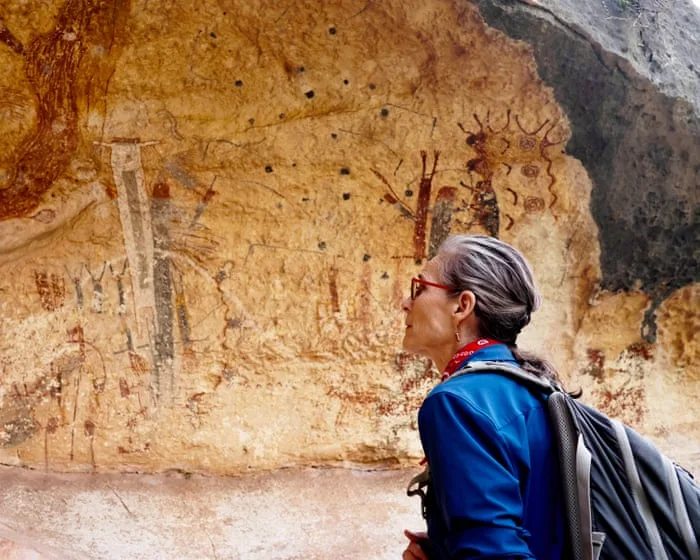
O n an overcast summer morning, Carolyn Boyd, an archeologist at Texas State University, stood at the foot of a cave in west Texas, looking up toward a series of towering murals painted on a rock wall. Three massive human-like figures soared toward an overhang that had sheltered the painting from the elements since they were drawn here perhaps 4,000 years ago.
An artist herself, Boyd knows how hard it would have been to paint these long, crisp lines. Before starting, the bands of Indigenous hunter-gatherers who lived in this west Texas valley, where the Pecos River empties into the Rio Grande, would have spent weeks pulverizing gypsum, hematite, limonite and manganese to make paint. They would have gathered massive quantities of sotol stalks to fold its fibers into scaffolding. The painting itself would have required teamwork and precision, with people at the bottom guiding artists on the wall as they painted figures stretching up to 30ft tall.
“As a muralist, I can tell you that just maintaining a straight line on an even surface is a challenge,” said Boyd. She’s spent 35 years analyzing these sites, some of which are older than the pyramids, and she describes them as a sprawling and still largely unreadable library storing some of humanity’s earliest stories.
“Look how perfect this line goes down and tapers,” she said, dragging a green laser pointer along its length. “It’s just stunning. I’ve brought fine artists, painters out here and they scratch their heads.”
The Trump administration is now dealing these rare treasures a potentially fatal blow. Last year, Republicans in Congress heaped a whopping $46.5bn for border wall expansion into Trump’s “big, beautiful” spending bill. The longest remaining unwalled stretch of the US-Mexico border lies in west Texas, a remote region that includes some of the state’s most-visited public lands, including the Big Bend national park.
Since February, Customs and Border Protection (CBP) has indicated it will use that massive war chest here to expand what it calls its “smart wall” – a mix of steel bollard fencing, vehicle barriers and hi-tech surveillance.
The area has remained unwalled until now, partly because geography already impedes most illegal crossings. Large ranches dominate the Mexican side, which contains no major cities and only few large towns to attract would-be migrants. Steep cliffs abound.
But with such vast sums on the table, CBP is pushing forward at breakneck pace with its plans – riding roughshod over virtually universal opposition from locals, business leaders and a growing number of political leaders from both parties. Most of that tension has focused on the controversy over CBP’s plans to mar the wilderness of the Big Bend national park, which the agency halted last week after activists publicized videos of bulldozers plowing up ground at the park’s famed Santa Elena Canyon.
The impending construction also threatens to mar or destroy an untold number of these millennia-old rock art murals that stand in the coming wall’s path.
5News aggregated this summary from the outlet’s public feed. The full article, with all the context, is on www.theguardian.com — the content belongs to The Guardian US.