Something Crashed Into the Moon in 2024, Leaving a Curiously Cold, ‘Once in a Century’ Crater
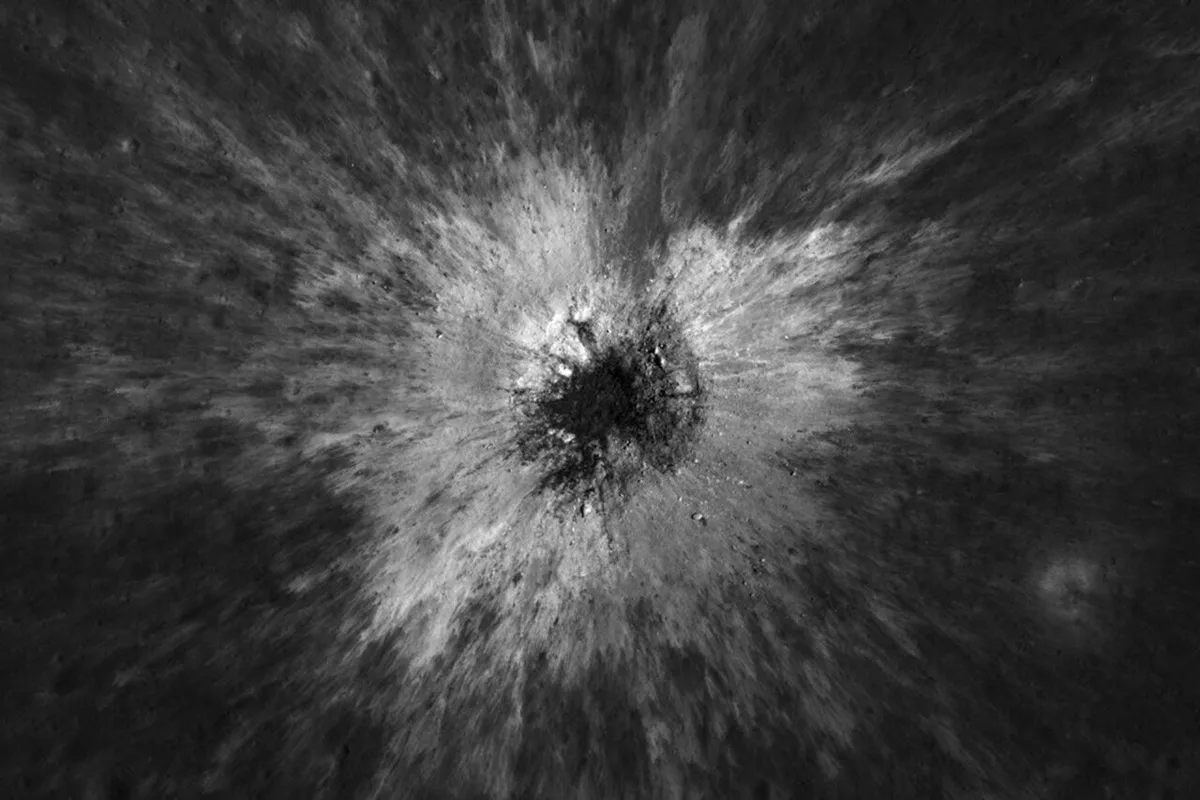
Two years ago, something about the size of a small apartment building, three- to six‑stories-tall, crashed into the Moon—and evidence of its impact went unnoticed for over a year. The object was probably a picayune space rock or an icy comet. (Although a boy can dream, can’t he?)
Whatever it was, the object smashed a gigantic, “once in a century” crater into the lunar surface, according to NASA’s announcement of the new find. The new crater spans 728 feet (222 meters) in diameter, carved about 141 feet (43 meters) deep, which for context is a little more than 20 feet shy of the height of the Arc de Triomphe in Paris. Researcher Robert Wagner of Intuitive Machines made the discovery via NASA’s Lunar Reconnaissance Orbiter Camera (LROC), which the firm now manages on NASA’s behalf after the firm hired the space agency’s principal investigator for LROC, Mark Robinson.
“It was by far the most obvious impact debris pattern I’ve ever seen in one of these images,” Wagner said in NASA’s announcement.
“I just stopped, dropped everything, and started looking into what that spot was,” Wagner recalled of the moment he first noticed the crater on October 24, 2025.
Working with the nonprofit Lunar and Planetary Institute ( LPI ) and NASA, Intuitive Machines’ team estimates that this still mysterious object collided with the Moon sometime between April 11 and May 22, 2024. The researchers, who published their analysis in the journal Science Advances on Wednesday, have named the crater McGetchin, after Apollo mission lunar field geologist Tom McGetchin .
“Crater production models indicate that an impact of this magnitude is expected to occur only once every 132 years on the Moon,” The research team wrote in the new study. “As such, this event constitutes a statistically rare, effectively once-in-a-lifetime observation.”
Wagner, an image-processing specialist at Intuitive Machines, made the find while stacking “before” and “after” images from LROC’s Wide-Angle Camera.
5News aggregated this summary from the outlet’s public feed. The full article, with all the context, is on gizmodo.com — the content belongs to Gizmodo.