Champagne growers race to preserve quality in record-early harvest
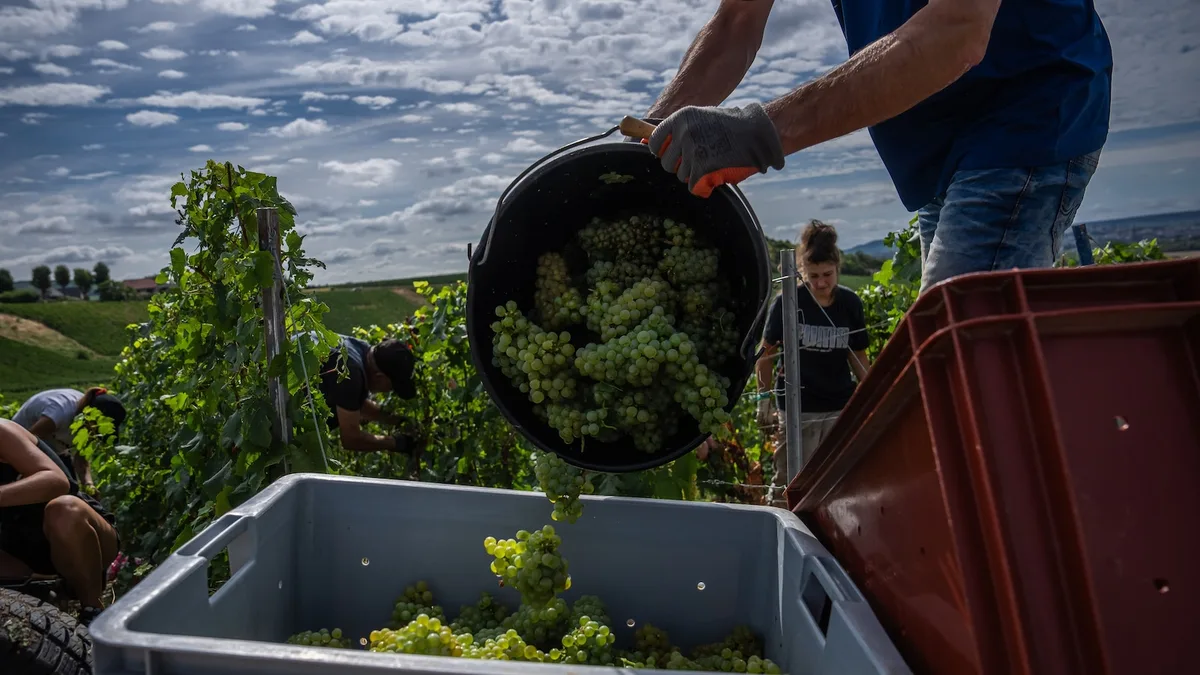
Champagne producers are racing to pick grapes as the region experiences its earliest harvest on record
HAUTVILLERS, France -- Champagne producers are racing to pick their grapes as the region’s earliest harvest on record gets underway, after extreme heat and drought accelerated ripening, leaving growers a narrow window to preserve the quality of the region’s world-famous sparkling wine.
On the hillsides of Hautvillers, teams of grape pickers start work at 6:30 a.m. among rows of vines that were recognized as a UNESCO World Heritage site in 2015.
For Alexandre Gobillard, production director at the Gobillard & Fils Champagne house, beginning the harvest in mid-August was once almost unthinkable.
“It’s historic in Champagne,” he said. “I’ve been working at the estate for 30 years, and when I started, my father used to tell me: ‘On Aug. 15, go on vacation.’ Today, it’s Aug. 18 and we’re in full harvest. We’ve never seen anything like it.”
At 50, Gobillard represents the fourth generation to work the family vineyards. Gobillard & Fils grows 40 hectares (about 100 acres) of vines and produces about 1.5 million bottles a year.
Champagne’s official harvest opened between Aug. 12 and Aug. 17 this year, depending on the area and grape variety — roughly a month earlier than what was once common in the region.
A late-March frost hit vines after mild temperatures triggered early budburst, reducing the potential crop. It was followed by four heat waves, which never happened before, Gobillard said.
Sun-scorched grapes turned partially brown, something Gobillard said he had rarely seen. He explained that losing roughly 10% of the grapes would mean a loss in volume rather than affect the quality of the wine.
Earlier harvests have become increasingly common in Champagne and other French wine regions as temperatures rise. In neighboring Italy , extreme heat has also prompted sparkling-wine producers to harvest sooner and pick grapes at night .
David Chatillon, president of the Union of Champagne Houses, acknowledged weather conditions this year will lead to a clear decrease in yields.
“But it’s not just because of the drought,” he said. “We lost 43% of the potential production to the spring frosts, and the drought has clearly made the problem of lower yields even worse.”
Chatillon said climate change has been a focus of the industry for the past 25 years, prompting investment in research and innovation to adapt to evolving conditions, including developing grape varieties that are more disease-resistant and ripen later.
“My grandfather’s generation harvested 100 days after flowering, my father’s 90 days, and today we’re down to 80,” he said. “We’re going to have to change our habits.”
5News aggregated this summary from the outlet’s public feed. The full article, with all the context, is on abcnews.go.com — the content belongs to ABC News Money.