Astronomers witness supermassive black hole gorge on a cosmic meal before 'burping' radio jets 300 days later
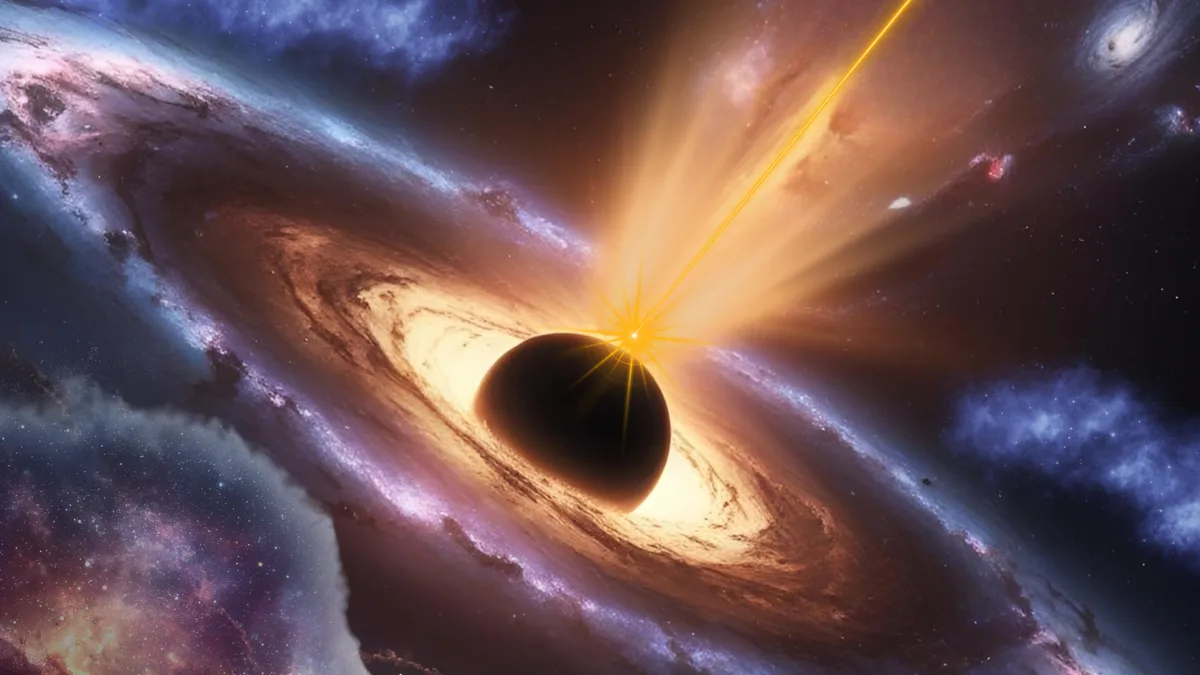
Using the NASA X-ray spacecraft Swift combined with radio observations, astronomers have observed a supermassive black hole burping radio jets 300 days after a heavy cosmic meal.
The team was also able to roughly estimate the mass of this feeding cosmic titan, which sits at the heart of the Perseus Cluster, a massive collection of thousands of galaxies.
The black hole sits at the center of the galaxy NGC 1275, located around 225 light-years away, and is the brightest galaxy of the Perseus Cluster .
The supermassive black hole first flared in X-rays, which indicated an increase in the rate at which it was accreting matter.
Actively feeding supermassive black holes sit in regions called active galactic nuclei (AGNs), with their immense gravity heating surrounding matter, causing them to glow brightly.
These emissions are boosted by material channeled to the poles of the central black hole, from where it is blasted out as powerful twin jets that shine across the electromagnetic spectrum , particularly in radio waves.
The observation of the following radio jet from the AGN at the heart of NGC 1275 via flaring in radio waves is crucial for understanding the relationship between the disk of matter that surrounds and feeds the black hole, called an accretion disk, and the jets it launches.
This so-called disk-jet coupling is key to developing a better picture of how black holes influence star formation in the galaxies in which they sit, and thus the growth of those galaxies.
Making these observations is no mean feat.
The ideal spacecraft for observing X-ray emissions is Chandra , but it doesn't observe NGC 1275 frequently enough to observe its long-term behaviour.
NASA's Neil Gehrels Swift Observatory may lack the power of Chandra, but having launched in 2004, it has collected a vast amount of data regarding NGC 1275 and its central supermassive black hole.
"It is fairly difficult to see the inner region of this AGN because NGC 1275 is at the center of the massive Perseus cluster of galaxies , which adds additional light to our observations," team leader Sarah Ketchum of the University of Michigan told Space.com.
"We developed a model that allowed us to remove the cluster emission from archival Swift data, and in doing so, we were able to see the changes in the X-ray flux from gas accreting onto the black hole in NGC 1275, from 2007 to 2025." Ketchum added that the capabilities of Swift were key to this investigation of NGC 1275, which is the ideal laboratory for the study of disk-jet coupling.
"There have been studies on other galaxies with AGN that show evidence of coupling between gas accretion traced in X-ray light and gas ejection in jets, traced in radio light.
5News aggregated this summary from the outlet’s public feed. The full article, with all the context, is on www.space.com — the content belongs to Space.com.