Household income hits record, but lower earners lose ground
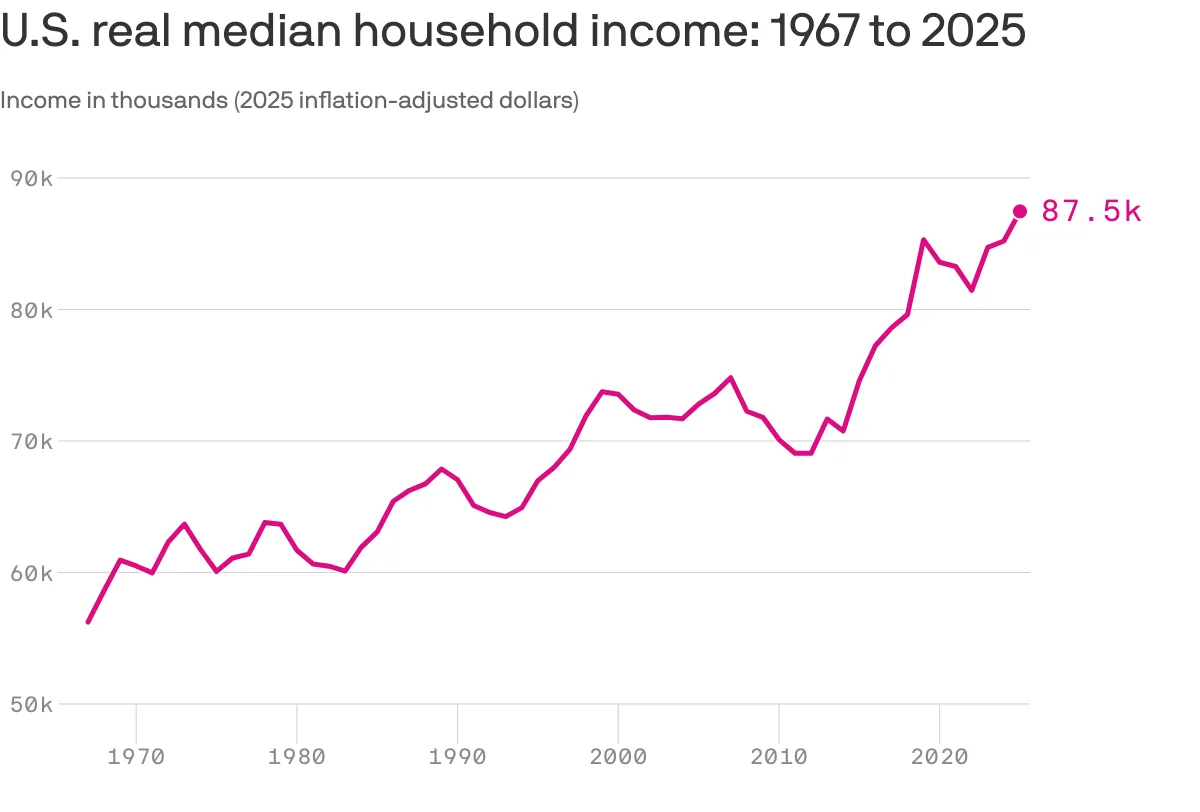
Data: U.S.
Census Bureau, Current Population Survey, 1968 to 2026 Annual Social and Economic Supplements ; Note: Census identifies breaks in the series in 2013 and 2017 due to methodological changes; Chart: Russell Contreras/Axios U.S. household income hit a record in 2025, but the lowest earners barely shared in the gains, new Census data show.
Why it matters: On paper, Americans look richer than ever.
But broader measures of financial security show millions still getting squeezed by medical costs , uneven income gains and a thinning public safety net.
The 2025 Census report largely captures the economy before the major safety-net reductions in President Trump's " Big Beautiful Bill" took hold.
That makes this year's record income and near-record-low official poverty numbers an important benchmark for measuring what happens next.
By the numbers: Real median household income rose 2.6% to $87,460 in 2025, the highest inflation-adjusted level since Census records began in 1967.
Median post-tax household income climbed 3.1% to $76,060.
The official poverty rate fell for a third straight year, dropping slightly to 10.2%, or about 34.5 million people.
Child poverty fell to a record-low 13.4%, while poverty among Hispanics dropped to an unprecedented 13.9%.
State of play: The economy delivered historic topline numbers without spreading the gains evenly.
Income among the wealthiest 10% of Americans rose 1.7%, while income among the bottom 10% showed no significant change — indicating that the low-income households largely missed out on the gains.
Households at the 90th percentile earned about $261,300, more than 13 times the roughly $20,010 earned at the 10th percentile.
The top fifth of households captured 52.4% of all household income.
5News aggregated this summary from the outlet’s public feed. The full article, with all the context, is on www.axios.com — the content belongs to Axios.