America’s Rural Lands Are Burning
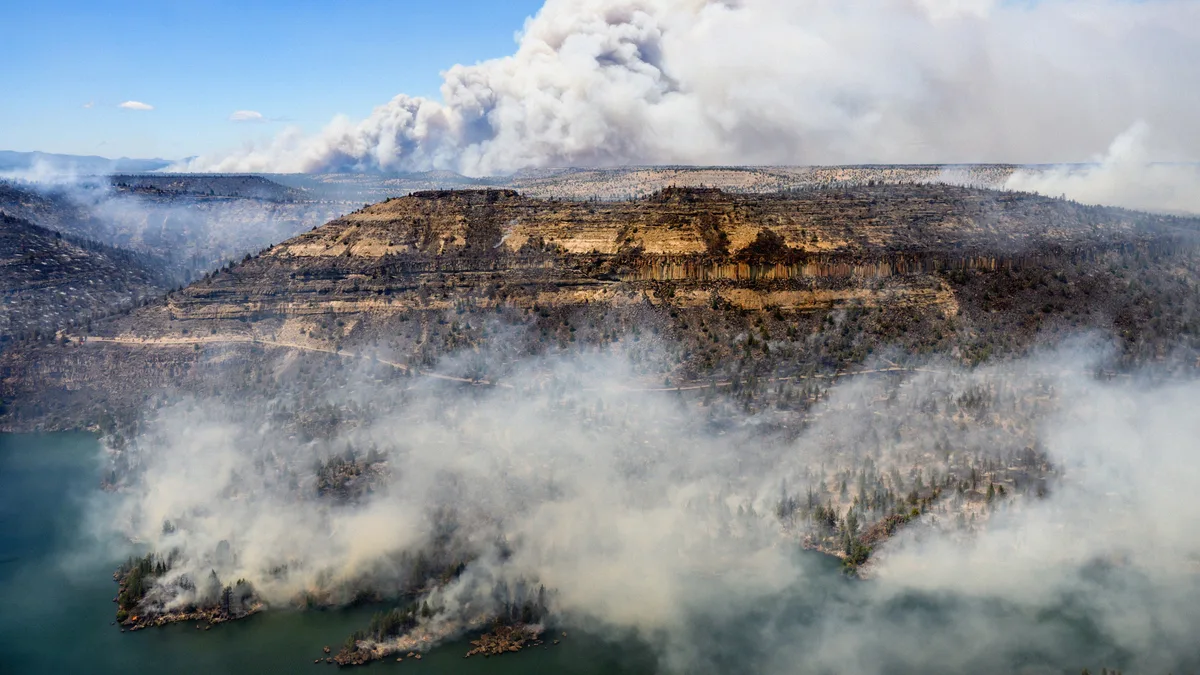
The summer of 2026 has been one of extraordinary fires.
In Europe, they have burned hundreds of thousands of acres in France and Spain and destroyed homes across England; they killed 13 people in Spain last month , and an elderly couple in Greece this weekend .
In Canada, fires have consumed an expanse of forestland larger than Belgium—which is also battling its biggest recorded wildfire.
In the United States, about 7.2 million acres have burned, the largest year-to-date area in the past decade and nearly double what it was at this time last year, according to data from the National Interagency Coordination Center.
Allison Rayburn, a program coordinator for the Oregon Department of Forestry, told me that in the eastern part of the state, “you can barely see the sun” through the smoke: “It’s just devastation, and miles and miles and miles of blackened landscapes.” In Europe, many of the fires have threatened populated areas, but in the U.S., much of the area burning in the West has been rural.
Near the Oregon town of Jordan Valley, the Big Grass Fire has been burning since July 23 and is among the largest fires in the state’s modern history; toward the end of last month, it hopped a canyon and crossed the border to Idaho, where the smoke from this and other fires made the air quality the worst in the country.
The complex of fires in Spokane, Washington, flattened entire neighborhoods; three other wildfires 10 times its size are burning elsewhere in the state.
If 2025 was a year of urban fire that destroyed large swaths of Los Angeles, 2026 is a year of rural fire, Daniel Swain , a climate scientist at the University of California Agriculture and Natural Resources’ research unit, told me.
“This is an extraordinary fire season in the American West,” Swain said.
“It just hasn’t been in California”—which usually accounts for much of the nation’s fire activity and its media attention.
Many of the biggest fires this year started because of back-to-back lightning strikes and have grown because of extreme heat, drought, and dry fuel left behind after an unusually warm winter.
They’ve destroyed grazing land and crops, killed livestock, and incinerated fruit that was just shy of harvest.
Many of the ranchers and government employees I spoke with compared 2026 to Oregon’s devastating fire season two years ago, when 1.9 million acres burned across the state; already this year, residents have lost hundreds of thousands more acres than that.
When I spoke with Dave Upthegrove, Washington’s commissioner of public lands, he was driving from the fires in Spokane to one near Walla Walla that was threatening the town’s water supply; the week before, he’d visited the burn area of the 150,000-acre Sinlahekin Fire.
5News aggregated this summary from the outlet’s public feed. The full article, with all the context, is on www.theatlantic.com — the content belongs to The Atlantic.