Astronomers spot something positively enormous behind the Milky Way
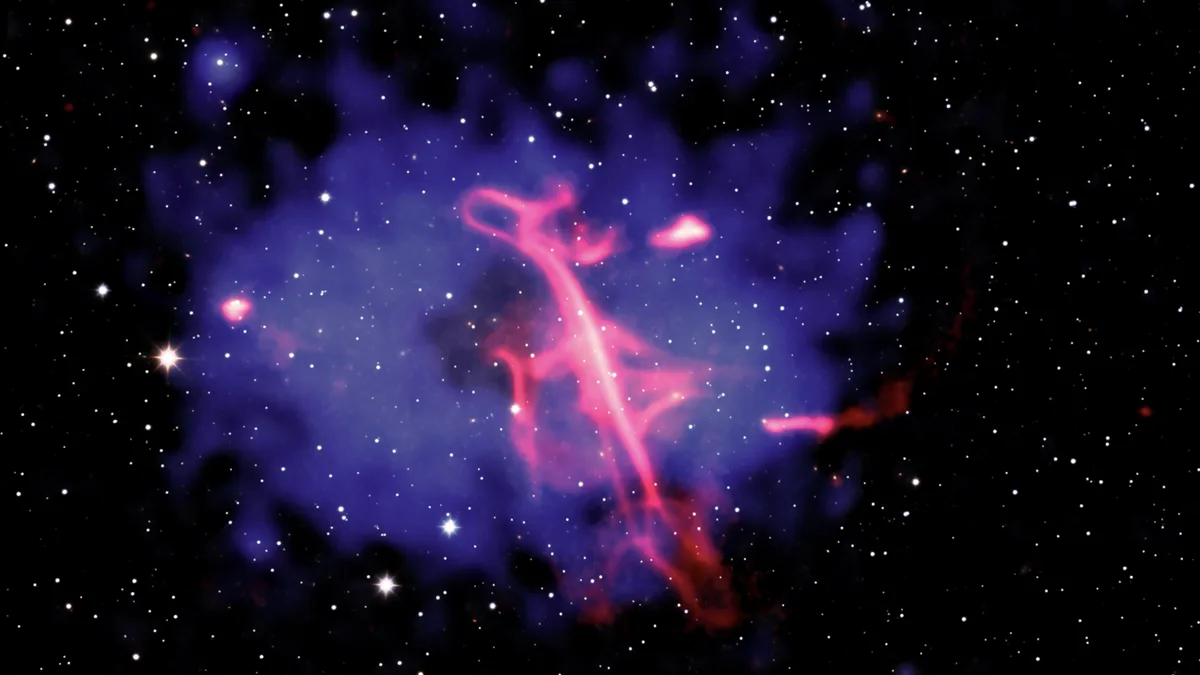
Astronomers peering past the crowded, dusty plane of the Milky Way have spotted a tangle of radio light , glowing inside a massive collision of lots of galaxies.
The space object loops and curls in thin strands, earning its nickname, the Treble Clef.
It's what researchers refer to as a "radio phoenix," a cloud of faded particles brought back to life.
It lurks inside a galaxy cluster — a huge group of galaxies bound together by gravity — and that cluster is in the throes of a merger with another cluster .
Long ago, a giant black hole in the cluster fired out jets of energetic particles.
Over time, those particles lost energy and went dark.
Then, the violent crash squeezed and stirred the leftover material, and it lit up again in radio light.
The discovery shows how far radio astronomy has come, according to the researchers, whose paper appears in the Astronomy & Astrophysics journal.
A new generation of telescopes tuned to long radio waves, especially the European Low Frequency Array (LOFAR) network , now captures images sharp and sensitive enough to resolve blurry smudges into detailed filament tapestries.
Radio telescopes also "see" through the gas and dust that block ordinary telescopes.
SEE ALSO: Artemis II crew witnessed meteor flashes on the moon with their own eyes The Treble Clef first surfaced in radio surveys years ago, and some astronomers thought it might be a pulsar , a fast-spinning dead star.
A 2004 study tied it to a possible galaxy cluster, but still couldn't make out its shape because the telescopes of the time couldn't pick out fine enough detail.
After that, the object faded from view in the scientific literature too.
It popped up once more, in a 2022 list of possible "X-shaped" radio sources.
5News aggregated this summary from the outlet’s public feed. The full article, with all the context, is on mashable.com — the content belongs to Mashable.