The Flying Car Must Never Be Built

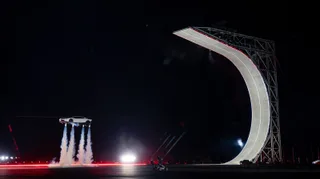
Elon Musk revealed, in a dramatic demonstration on Thursday night at SpaceX’s rocket-testing facility near Waco, Texas, a new “flying” Tesla Roadster prototype.
The car hung upside down on a curved track, then performed aerial stunts—including jumping over a Tesla semi, Evel Knievel–style—using air-powered thrusters designed in collaboration with SpaceX.
The demo was impressive despite Musk’s awkward manner, which in the context of a supposed literal flying car came off as nerdy charm.
After revealing the car, Musk paraphrased a quote from Peter Thiel, his former PayPal partner: “We wanted flying cars, instead we got 140 characters.” The line, which was part of a 2011 “manifesto” published by Thiel’s venture-capital firm Founders Fund, was intended to indict the feeble ambition of the technology industry.
Instead of solving big, important challenges, the world’s smarts—and money—had been devoted to small-potatoes social-internet start-ups such as Twitter.
One obvious oddity of the line—which has since been removed from the manifesto —is that Founders Fund’s most important investment at the time was Facebook, a social-network platform.
But another is the idea that anyone actually wanted a flying car for real.
That ambition may never have represented an actual dream.
Like a jet pack, a flying car represents not just the future but the idea of individual freedom delivered through technological conquest.
Taken at face value, a flying car is not an impressive dream—or at least it hasn’t been since the Wright brothers more or less attained it.
Automobiles have always moved on the ground by rolling via motor.
The earliest practical airplanes also rolled until they flew (and hopefully landed again).
An airplane is, in a way, merely a car with wings. [ Derek Thompson: Why flying cars are an impossible dream ] In 1917, Glenn Curtiss built literally that: His Curtiss Autoplane was an automobile with detachable wings and a propeller.
It never really flew effectively, but the idea persisted.
5News aggregated this summary from the outlet’s public feed. The full article, with all the context, is on www.theatlantic.com — the content belongs to The Atlantic.