Zelda: Ocarina of Time is my favorite video game ever. After playing the remake, I get the vision.
As fun as it is to be an iconoclast at times, one of my most basic opinions is that The Legend of Zelda: Ocarina of Time for Nintendo 64 is one of the all-time greats.
There is, of course, a rose-colored tint to that take.
Seeing the vast, explorable world of Ocarina for the first time as a child is basically why I love video games now.
I was so taken with the idea of looking out onto an expansive horizon and knowing that anything could be out there that I became obsessed with the medium and, well, now I play video games for work.
It hit me at just the right time in my life to make a permanent impression on me, and I'm still chasing the high of the first time you step out onto Hyrule Field to this day.
All of that is to say I should, in theory, be as scrutinous as anyone regarding the upcoming Ocarina of Time remake for Switch 2 .
But after playing it for about an hour at a recent Nintendo press event, I came away confident that there is a vision here beyond just "let's remake an old Zelda game so we have something to market alongside the upcoming movie." The Ocarina of Time remake feels tangible and hand-crafted That's not what hallways are supposed to do.
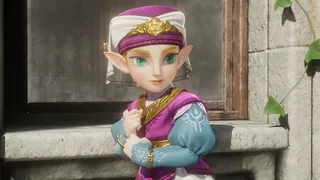
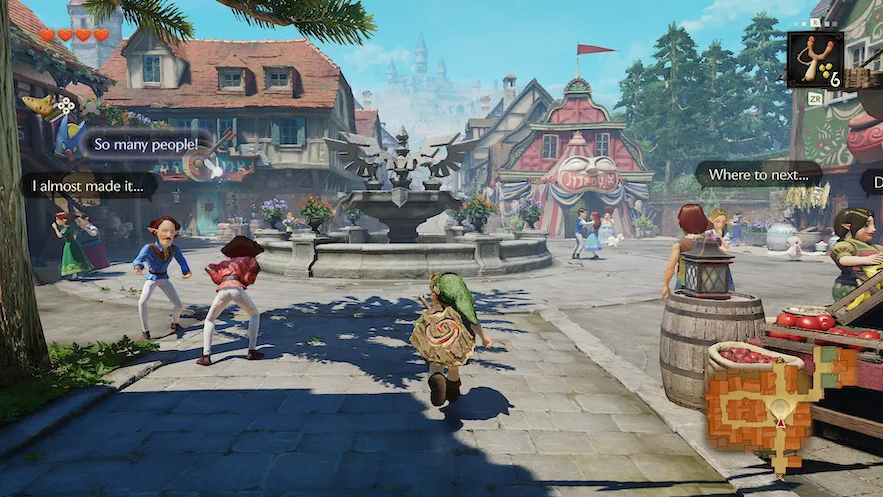
Credit: Nintendo Nintendo's chosen visual style for this Ocarina remake has been divisive among fans.
It's undeniably an impressive technical showcase for the Switch 2 hardware, featuring many advanced graphical techniques at a ridiculously smooth frame rate that the original Switch could never have dreamed of.
However, it ditches the mildly anime-coded look of the more recent open-world entries in favor of exceptionally high levels of detail across nearly every texture, juxtaposed with characters who resemble puppets or action figures more than people.
It's admittedly an odd look at first, but after seeing it running natively on a TV in front of me rather than through a YouTube window, I see what they're going for.
Nintendo is taking what is, by contemporary standards, a very small video game world and filling it with as much detail as possible, as opposed to the less-defined look of the huge open-world games.
It's not dissimilar to Yakuza , a series known for tiny open worlds that feel impressively real and lived-in.
The end goal, I think, is to take a fantasy world originally rendered in the foggy, blurry form on Nintendo 64 hardware, and make it feel tangible and believable.
5News aggregated this summary from the outlet’s public feed. The full article, with all the context, is on mashable.com — the content belongs to Mashable.