America has more majority-minority rural counties than urban and suburban ones
Data: U.S.
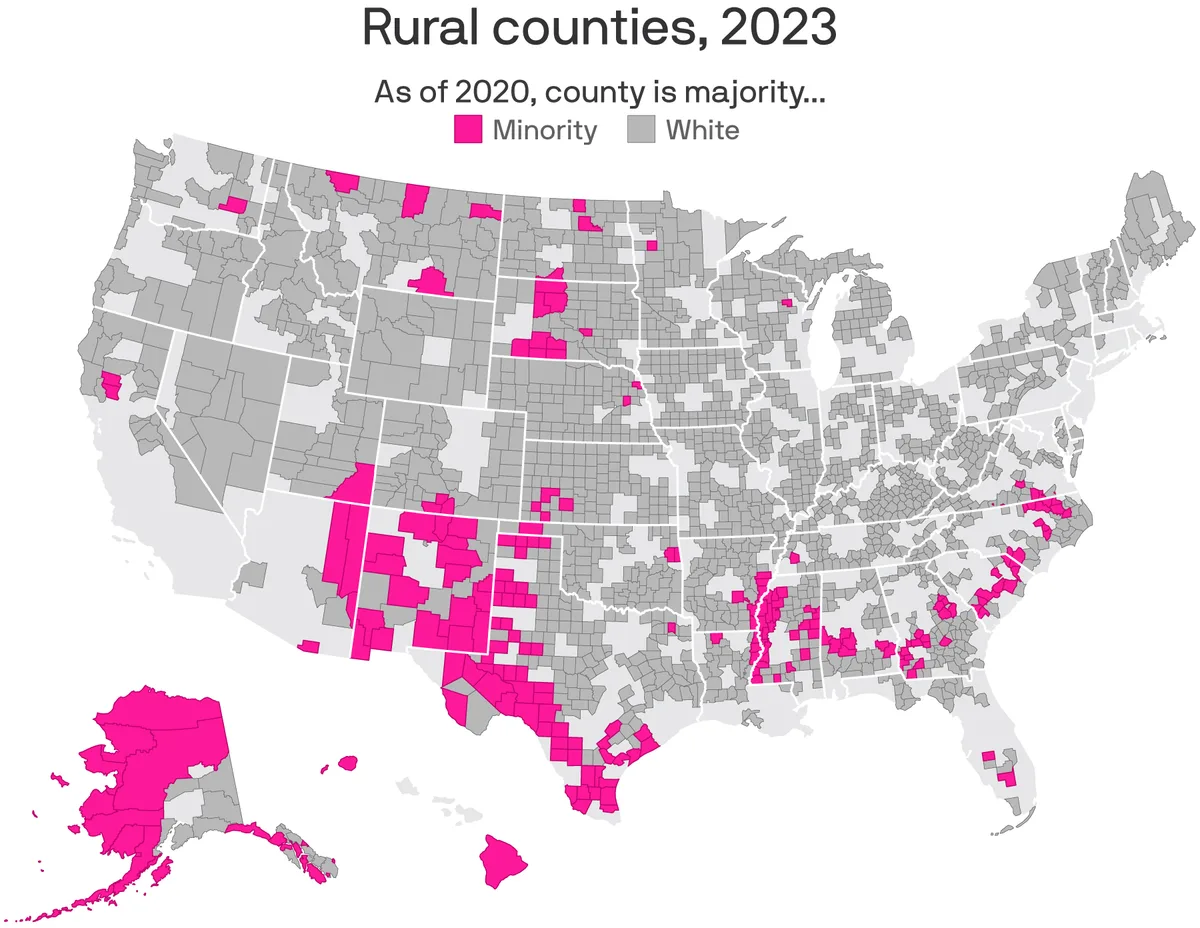
Census, USDA ; Chart: Erin Davis/Axios Visuals The U.S. is projected to become majority-minority in 2046, but hundreds of rural pockets crossed that demographic benchmark years ago, an Axios analysis finds.
Why it matters: The evolving face of rural America, driven both by immigration and increased mobility, has invigorated communities, increased their diversity — and presented new challenges.
Rural governments dealing with rapid change, for example, often have few interpreters, bilingual election workers or translated materials — the machinery that turns civil-rights protections into access.
Population shifts, particularly in rural areas, can leave schools, courts and election offices struggling to catch up.
The demographic transformations are evident in Kansas and Nebraska, where immigrants work in meatpacking plants, in Hispanic communities in South Texas and mostly Black areas of the South, and in Alaska's Native population centers, where white residents are leaving or dying off.
The shifts are putting unprecedented pressure on rural schools, courts, health departments and election offices, which often are cash-strapped with limited personnel.
At the same time, the Trump administration has revoked a longstanding federal language-access directive and narrowed some anti-discrimination enforcement tools.
By the numbers: An Axios analysis of federal data finds that 403 U.S. counties — roughly 12.8% of the national total — already are majority-minority.
That includes 221 "non-metro counties" and 182 counties in urban and suburban metro areas.
The non-metro or rural counties are spread across 27 states and have a combined estimated population of roughly 4.5 million.
Of those rural counties, 205 — or 92.8% — had fewer than 50,000 residents, the Axios review found.
Zoom in: Texas leads the nation with 57 rural majority-minority counties — all Hispanic along the Southern border and into the oil-rich Panhandle.
Mississippi has 25 such counties, followed by New Mexico with 18, Georgia with 17 and Alaska with 15.
5News aggregated this summary from the outlet’s public feed. The full article, with all the context, is on www.axios.com — the content belongs to Axios.