The Best Possible Dish for September Has Three Simple Ingredients. Don’t Miss It.
Sign up for the Slatest to get the most insightful analysis, criticism, and advice out there, delivered to your inbox daily.
At the La Jolla restaurant Fleurette, I sat at the bar and listened to the man beside me speak highly about his burger and the truffle that he’d opted to have grated atop the patty. The bartender, meanwhile, couldn’t stop singing the praises of the spot prawn special on the menu, explaining how Fleurette and Callie, Chef Travis Swikard’s two restaurants, were the only places in all of San Diego County to offer this type of shrimp on its menus. The fisherman, I was told, was the only one in the county with a spot prawn license and delivered his entire haul—a few hundred prawns each week—exclusively to Swikard.
But while everyone gave kudos to burgers and shrimp, I felt that, after one bite, I had ordered the best dish of the lot. Simple elements, common ingredients, and yet I’d never seen them combined on a plate before. The whole appeared so meant-to-be that every chef—even regular home chefs—could replicate it with relative ease. And you ought to try. As the seasons begin to change over the course of this month, this is the perfect dish to celebrate the last of summer’s warmth with some of its loveliest flavors.
Before I get into how you can make a straightforward version of this gem of a plate—which I’ll generalize to calling Fish Crudo with Melon and Tomato Water (that’s right!)—allow me to share how I’ve seen it interpreted by the professionals.
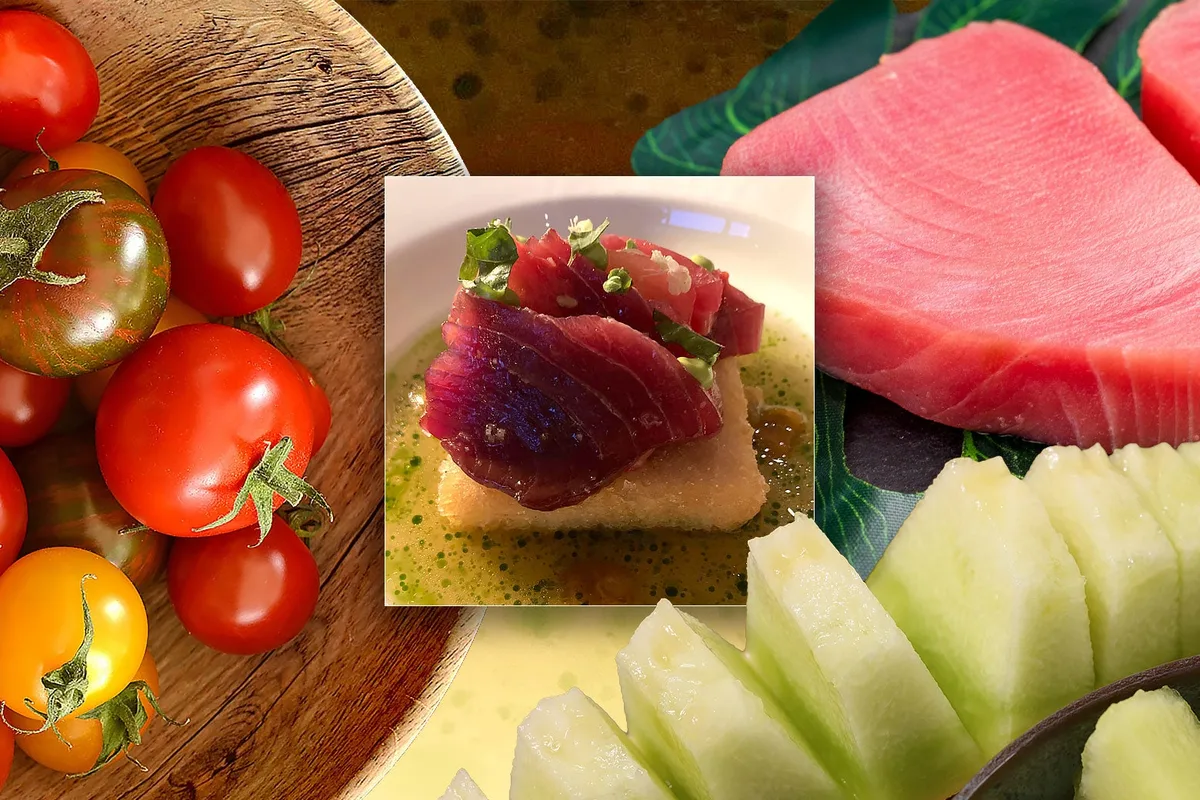
When Swikard’s “Bluefin Crudo” was set before me, I studied the thick, ruby red cuts of raw Bluefin tuna layered over thin watermelon slices. The melon looked almost identical to the fish. The pair was fanned out over a fried rice cake that sat like a raft in tomato water (more on this later). In all the red were little bits of green: micro greens, dots of avocado cream, pearls of basil oil afloat in the tomato sea. The sweet watermelon had elements of salt and citrus, the tuna was rich and buttery, and the fresh, tart, and spicy tomato water brought balance.
Swikard had been inspired by acqua pazza , an Italian dish that translates to “crazy water,” where fish is traditionally poached in tomato sauce that’s less thick than, say, a marinara. “When I build a dish it’s about taste, texture, aroma,” Swikard told me. “It’s a balance of flavors.”
This preparation even involved sleight of hand. Swikard, wanting to make the watermelon slices look, taste, and feel like tuna, compressed them for 45 minutes with yuzu and Colatura di alici , an Italian fermented fish sauce made by aging anchovies for three years. As a result, the watermelon took on the tastes, textures, and aroma of tuna. The chef hardly manipulates the tuna itself, though he of course sources high-quality fish. But he does take that extra chef-y step, curing the Bluefin by layering it between sheets of kombu for four hours. This helps to bring out those natural umami flavors. Otherwise, the tuna is untouched and gains much of its seasoning from its proximity to the melon.
Swikard, it turned out, wasn’t the only chef playing with this trio.
5News aggregated this summary from the outlet’s public feed. The full article, with all the context, is on slate.com — the content belongs to Slate.