Supreme Court pauses lower court ruling on Trump's mail voting order as hurdles loom
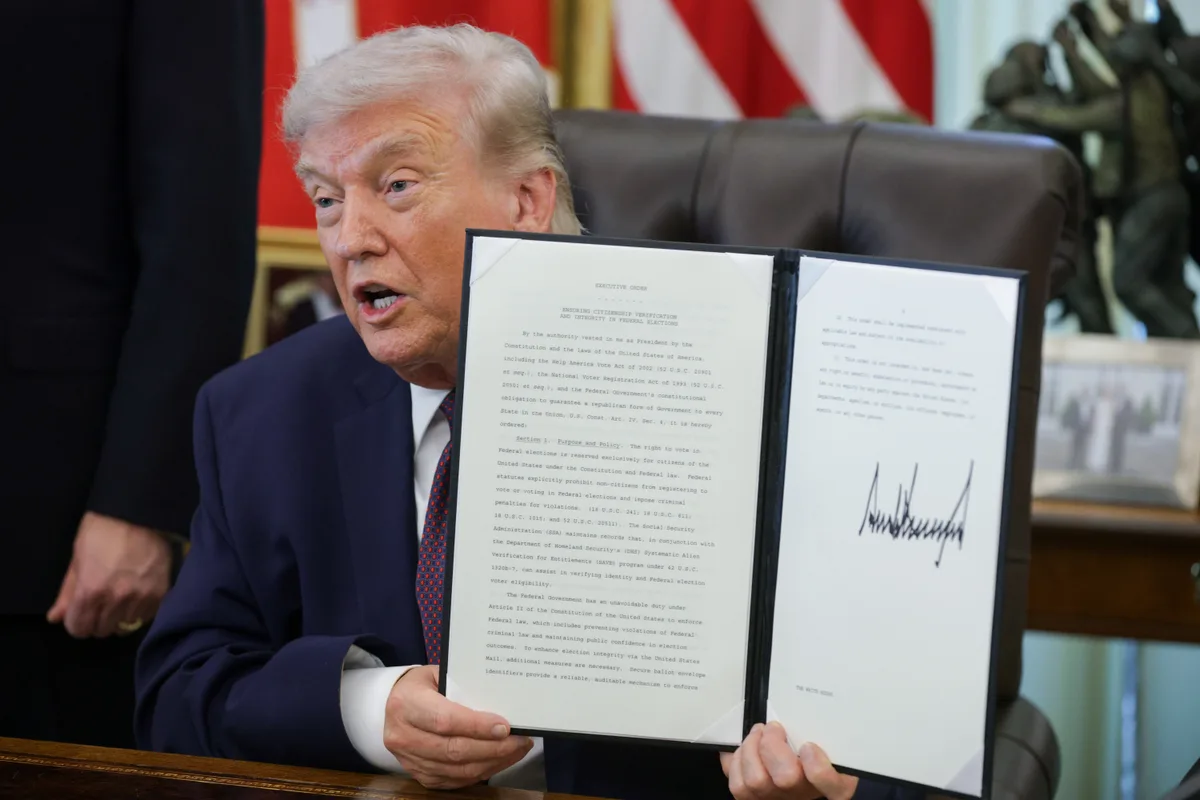
The Supreme Court has paused a lower court's ruling that blocked key directives from President Trump's executive order to restrict mail-in voting for this fall's midterm election in about two dozen states and Washington, D.C.
But with the start of absentee voting for the midterms just weeks away, legal and practical hurdles loom over whether the U.S. Postal Service and other federal agencies can finish carrying out Trump's directives.
Released Monday, the order marks the latest court action in the legal fight over Trump's March order — one of many efforts he has made to try to exert control over how elections are run.
As part of a separate but related lawsuit, the U.S. Postal Service remains blocked from following Trump's directives under a nationwide ruling released Aug. 11 by U.S. District Judge Indira Talwani in Boston.
The Supreme Court did not weigh in on the legality of Trump's executive order, which has so far not directly affected eligible absentee voters' option to cast ballots by mail.
In June, Talwani issued an earlier ruling that blocked key parts of Trump's order in the 23 mainly Democratic-led states, plus Washington, D.C., that sued the administration.
Trump's order calls for the Department of Homeland Security to develop state lists of adult U.S. citizens and for the Postal Service to obtain lists of eligible mail voters from states. According to the order, USPS is supposed to deliver mail-in ballots only to people on those lists. All election officials would also be required to have certain barcodes on their mail ballot envelopes.
The Postal Service has released a final rule for federal ballot mail in response to Trump's order.
Trump — who himself voted by mail as recently as this year in Florida — has said he issued this order to stop illegal voting by non-U.S. citizens in federal elections, which research has found to be infinitesimally rare.
Talwani's June ruling concluded Trump overstepped a president's authority under the Constitution , which gives power to state legislatures and Congress to set federal election rules. USPS, which is independent of a president's administration, also has no legal authority to control mail-in voting, the judge found.
The Supreme Court has now granted emergency requests from the administration and 12 Republican-led states to pause the judge's June ruling in 23 states and Washington, D.C., while not weighing in on the legality of Trump's order.
It remains unclear what impact the high court's order will actually have on eligible mail-in voters.
The legal fight is likely far from over, with a separate set of lawsuits led by Democrats and voting rights groups continuing to play out as this fall's election draws closer.
The administration has previously acknowledged the shrinking window of opportunity for the administration to implement Trump's order for this year's midterms. In a July court filing , U.S. Solicitor General D. John Sauer noted that there may not be enough time to resolve the legal challenges through the appeals process with the courts.
5News aggregated this summary from the outlet’s public feed. The full article, with all the context, is on www.npr.org — the content belongs to NPR Politics.