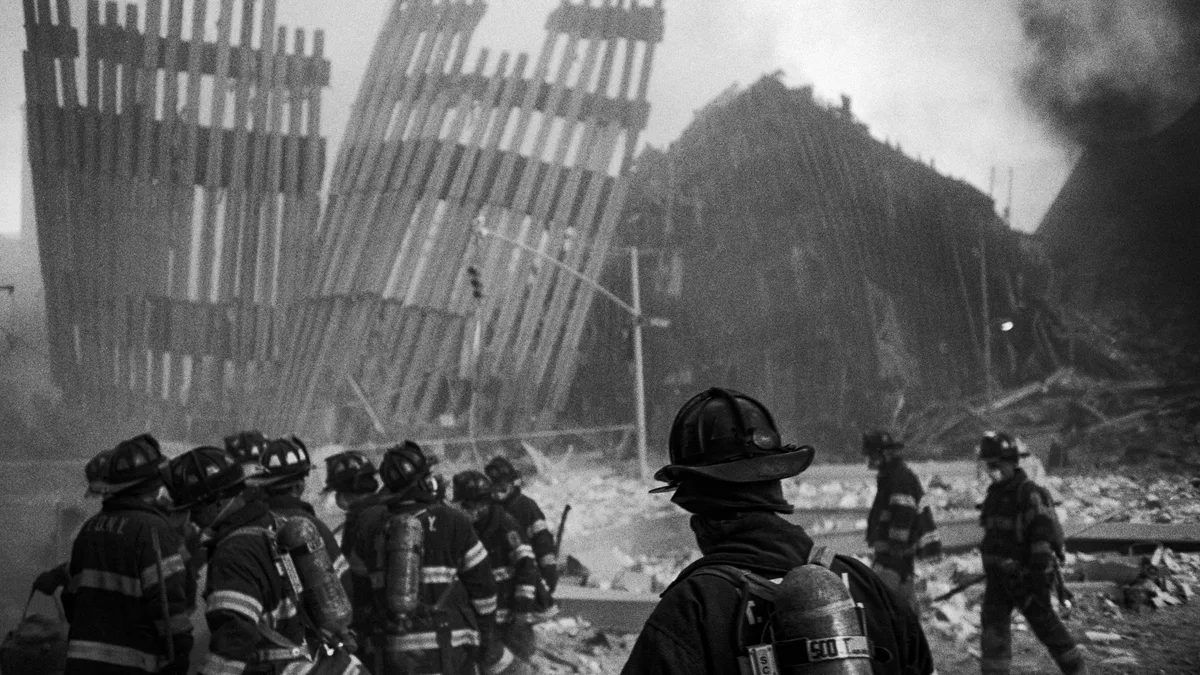
Postscript to American Ground: Unbuilding the World Trade Center
Editor’s Note: This article was adapted from the afterword to the 2003 paperback edition of William Langewiesche’s 2002 book, American Ground: Unbuilding the World Trade Center .
Langewiesche, who died in 2025, reflects here on reporting from Ground Zero as the only American journalist granted full access to the World Trade Center clean-up effort.
You can read part one of the American Ground: Unbuilding the World Trade Center series here ; part two here ; and part three here .
American Ground was originally an Atlantic series , and an attempt to respond usefully to the terrorist attacks of September 11, 2001.
As it became clear that the magazine was committed to a long and heavily charged project about the deconstruction of the World Trade Center ruins, I wanted to take some emotional distance from the tragedy, and to approach the narrative as if I were looking back on current events from several decades into the future.
The result would be, I hoped, like a “history in the present tense.” It was a formulation that came often to mind as I proceeded.
My unwillingness to participate in the public displays of grief was partly just personal.
But I also believed that the emotionalism surrounding the site, though at its origins genuine and necessary, had grown into something less healthy—an overindulgence, sustained by political forces and the media, that rather than serving as a catharsis only deepened the social anguish.
And I thought that if American Ground was to have lasting value, readers should not be manipulated; they would bring their own feelings and thoughts to the text.
My job was to observe for them, not as an “objective” journalist or an earnest encyclopedist, but more openly in the first person, as their agent on the ground.
I spent six months immersed at the site, usually seven days a week, and another five months writing.
I witnessed many sad moments, particularly when accompanying some of the families of the dead who came to contemplate their loss—but I did not write about that, because their grief was private, or should have been, and it was not my subject.
My subject was construction, or more precisely deconstruction—the dismantling of the tangled steel and concrete, and all that this entailed.
Now, nearly two years after the World Trade Center collapses, I still believe that the only way to communicate the essence of the cleanup, including the complexity of the emotions involved, was to maintain the narrative’s detachment.
5News aggregated this summary from the outlet’s public feed. The full article, with all the context, is on www.theatlantic.com — the content belongs to The Atlantic.