Another Pot of Paint Thrown in the Public’s Face
For several months, something discomfiting has been creeping onto San Francisco’s lampposts, bulletin boards, and restaurant windows: more and more signs, for run clubs and a July 4 parade and tacos, all of which are obviously entirely produced by generative AI.
This bothers me terribly. (Friends have called it a fixation.) But why does it bother me? A ChatGPT-generated poster for a garage sale seems legitimately dispiriting compared with a handwritten flyer, or even a haphazardly formatted Word document.
What about a bodega using an AI-generated image of a hamburger instead of a random piece of clip art pulled from the internet? It’s not like most of these flyers were ever going to be high art anyway.
Still, the issue nags at me constantly, whenever I pass one of these synthetic images plastered over the real world.
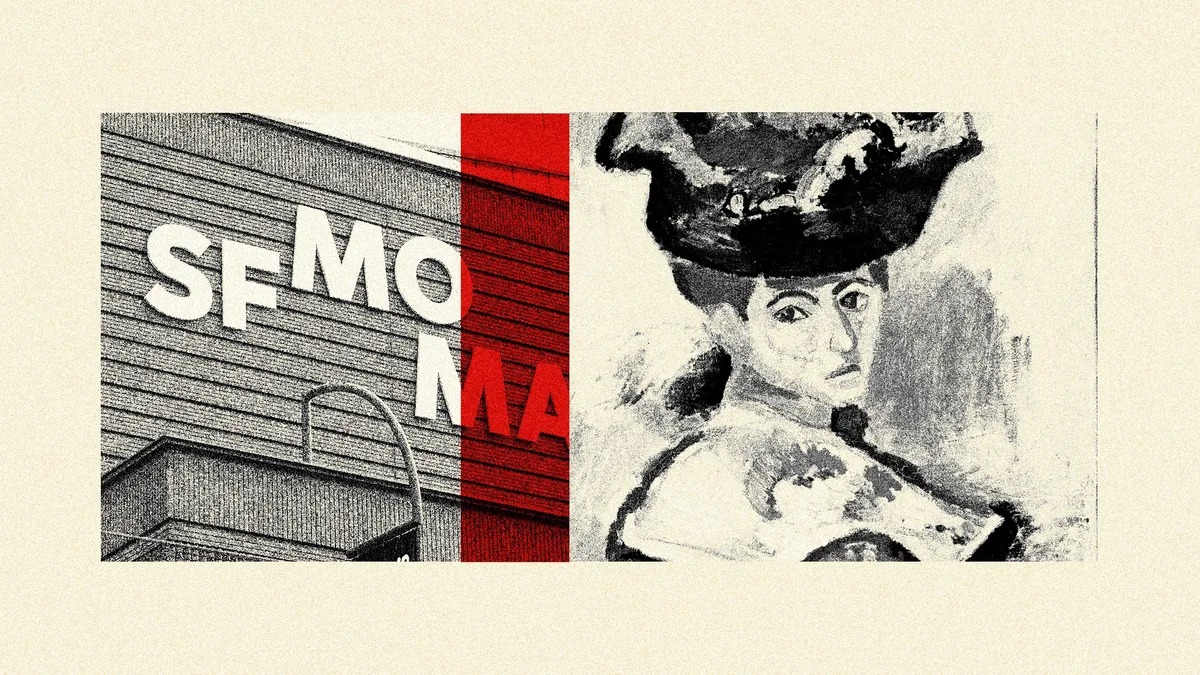
Last month, in part looking for reprieve from the AI onslaught, I went to what promised to be an imaginative new exhibition of Henri Matisse and other fauvists’ work at the San Francisco Museum of Modern Art.
The show was centered on Femme au chapeau (“Woman With a Hat”), a foundational painting in modern art.
Matisse depicted his wife with colors that were totally detached from reality: teal patches of skin, an orange-and-green neck, a phantasmagoric hat.
In 1905, when the painting debuted, this was scandalous: “A pot of paint has just been thrown in the public’s face,” one critic declared.
Walking through the galleries, I was taken aback by what struck me as a scandal of its own.
The museum, in collaboration with Google Arts & Culture, had used generative AI to augment visitors’ experience—in ways I found, at least initially, rather off-putting.
Part of the exhibition’s conceit was to re-create Femme au chapeau ’s historical context.
The museum commissioned a local artist to develop wallpaper that could have been in the palace where the painting debuted and worked with an animator to create a visual projection of the walls of Gertrude and Leo Stein’s living room, where the canvas hung for many years.
I loved all of that.
But an AI-generated animation of the streets of Paris circa 1905, with shadowy figures walking to the gallery and a dirigible floating above, felt more like a gimmick than historical immersion.
5News aggregated this summary from the outlet’s public feed. The full article, with all the context, is on www.theatlantic.com — the content belongs to The Atlantic.