Transcript: Rep. Ro Khanna on "Face the Nation with Margaret Brennan," Sept. 20, 2026
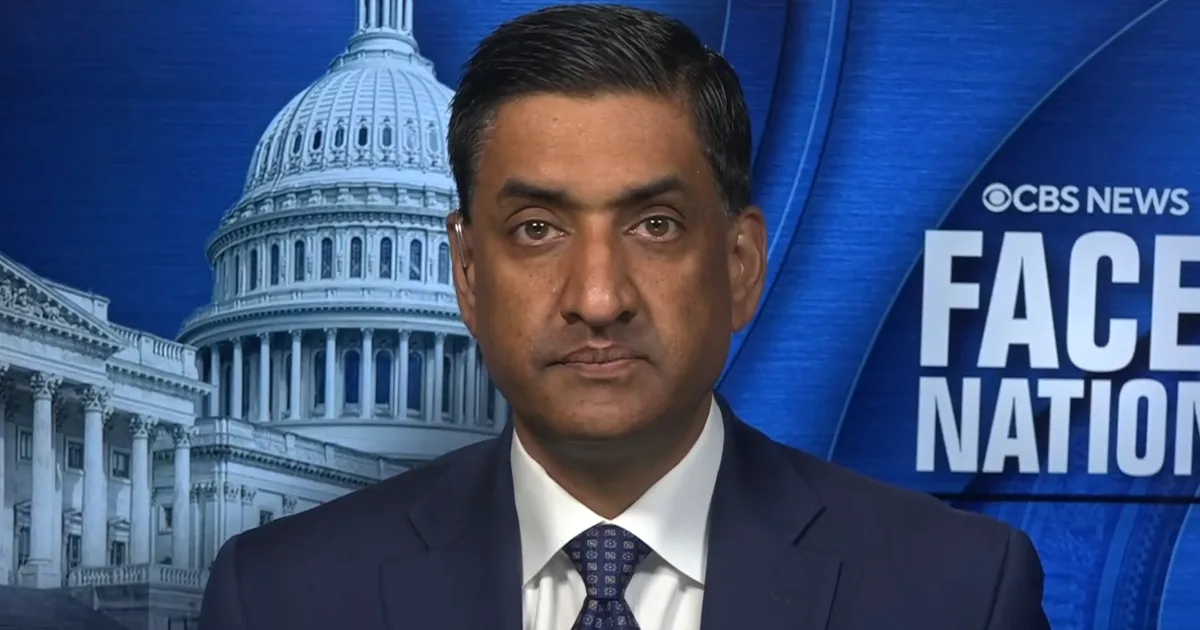
The following is the transcript of the interview with Rep. Ro Khanna, Democrat of California, that aired on "Face the Nation with Margaret Brennan" on Sept. 20, 2026.
MARGARET BRENNAN: We begin today with California Congressman Ro Khanna, who is the top Democrat on the Select Committee on the Chinese Communist Party, and he joins us from Fremont. Good morning to you, Congressman.
MARGARET BRENNAN: So China and the U.S. are in an arms race. You've proposed this idea that Chinese AI firms should cooperate with American companies. You sent letters to DeepSeek, Alibaba, other firms, urging them to follow the lead of the American firms like OpenAI and Anthropic to slow the rate of AI advancement until society develops guardrails, as you put it. Have any of these Chinese firms responded to your proposal?
REP. RO KHANNA: They have not. Winning an AI war is like winning a nuclear war. It is catastrophic for civilization. And what we have asked is that they agree to some basic terms. Look, there are two dangers to AI: either the loss of control or misuse, and the Chinese firms have taken no actions on either of them.
MARGARET BRENNAN: Well, I'm looking at what the FBI, the NSA, and Homeland Security, their division CISA, they have all warned that China-based AI companies are targeting and copying American artificial intelligence at what they describe as an industrial scale. So, how can you ask competitors to collaborate? Isn't it inherently at odds if they're stealing technology?
REP. RO KHANNA: Well, they're right that they are engaging in distillation. Basically, they are copying American models. That's one reason, frankly, to regulate American models because they're copying them. Some of the safeguards would protect the world, but at the same time, we also need an international agreement with Xi Jinping to have basic standards. That should include international monitoring, it should include checks through the data centers where you can tell whether a model is being used for inference or training, and it should use enforceable and verifiable tools. Now, obviously, you can't just trust the Chinese, but like any agreement, like an arms control agreement, as Reagan said, you need to trust and verify. And the world has done this before. There's no reason we can't do it when it comes to AI.
MARGARET BRENNAN: Well, I'm looking at Bloomberg's figures. They report China is preparing to spend about $300 billion over the next five years to build data centers across that country, which will be operated by state-owned firms. As you know, there's really no wall between the state and industry in China. So, when you are acknowledging they commit human rights abuses and their AI firms help the state to commit those abuses, aren't you asking the CEOs to- to do something that's at odds with what Xi Jinping is- is seeking to do?
REP. RO KHANNA: Well, the first ask is of Trump and Xi Jinping to come up with an international agreement, and two of the core principles should be one: banning any self-improving AI, recursive self-improving AI. That's basically AI that continues to improve itself, and where we could lose control.
5News aggregated this summary from the outlet’s public feed. The full article, with all the context, is on www.cbsnews.com — the content belongs to CBS News.