Rocket issues delay 1st-ever private mission to Venus: 'We are awaiting Neutron readiness'

The future of a privately backed robotic mission Venus seems about as cloudy as the planet itself at the moment.
Scientists based at the Massachusetts Institute of Technology (MIT) are working with the California-based company Rocket Lab to search for possible signs of life on Venus.
The first step in that program is the Rocket Lab Mission to Venus , which will deploy a small, nose cone-like probe crafted to sample the Venusian atmosphere using a device called an autofluorescence nephelometer (AFN).
That AFN can measure individual particles in Venusian clouds , constraining their size, shape and composition in a search for signs of organic molecules.But that undertaking, primarily fueled by private dollars, has been waylaid due to getting a needed booster flight-qualified.
Neutron readiness "We call ourselves the Morning Star Missions to Venus.
The Rocket Lab Mission is the first mission in the series," said Sara Seager, a noted professor of planetary science at MIT.
"Rocket Lab moved the project to the Neutron rocket , and we are awaiting Neutron readiness," Seager told Space.com.
Neutron was originally expected to debut in 2024 , but it has yet to make its maiden voyage.
That first flight, which will launch from Rocket Lab's Launch Complex 3 on Wallops Island, Virginia, also depends on the successful completion of the vehicle's qualification testing and acceptance program, according to the company.
While Venus probing via private means has been a bit booster-bushwhacked, there has been promising progress with the venture.
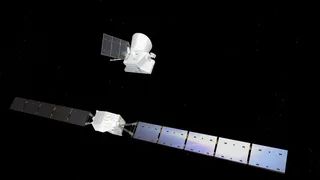
An illustration shows Rocket Lab's Photon spacecraft above the clouds of Venus (Image credit: Rocket Lab) Ready for Venus duty Rocket Lab is providing the shell for the entry probe.
NASA's Ames Research Center developed its heat shield, called the Heatshield for Extreme Entry Environment Technology (HEEET), which consists of woven material that can protect the spacecraft against temperatures up to 4,500 degrees Fahrenheit (2,500 degrees Celsius).
Also ready for Venus duty is the probe's pressure vessel.
Seager's team is providing the AFN, along with their ongoing, rigorous science preparation.
5News aggregated this summary from the outlet’s public feed. The full article, with all the context, is on www.space.com — the content belongs to Space.com.