ICE plans to outfit officers with electric shock gloves
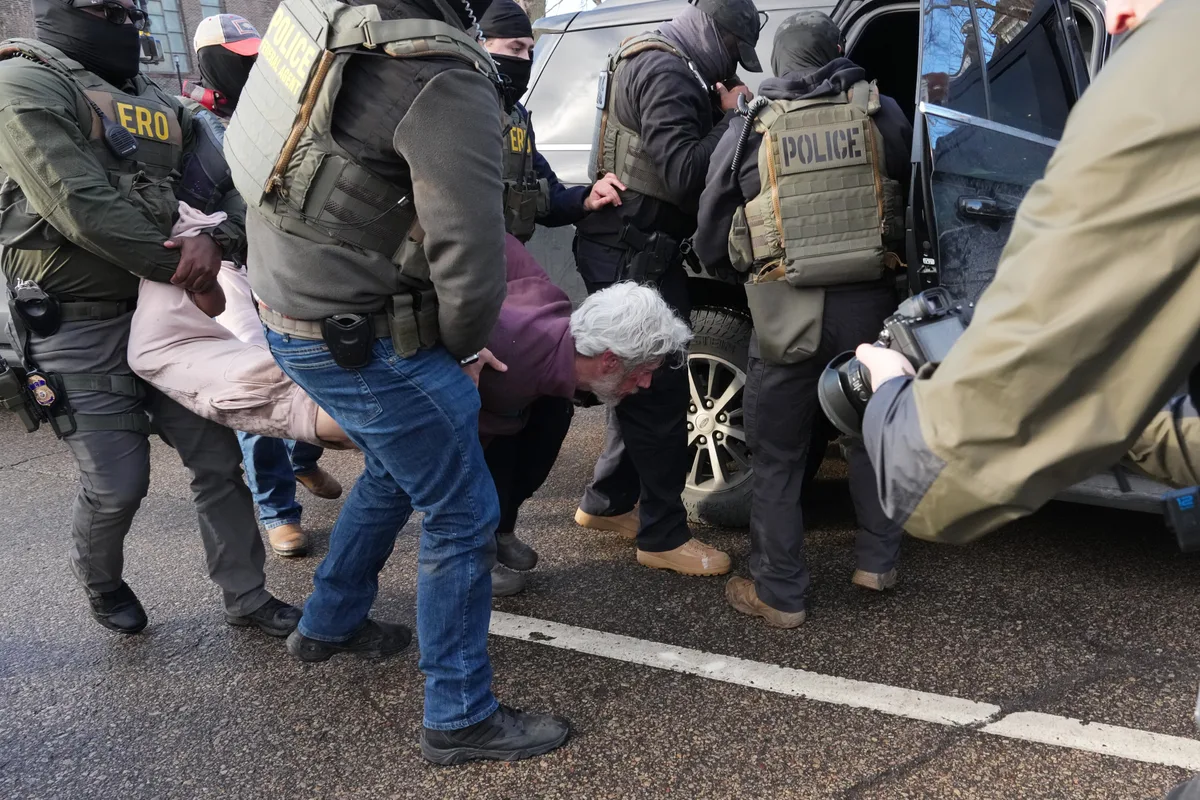
Protesters are arrested by federal agents near the scene where Renee Macklin Good was fatally shot by an ICE officer last January in Minneapolis. Adam Gray/AP hide caption
Immigration and Customs Enforcement is planning to give its officers high-tech gloves that deliver electric shocks to people they're trying to detain, according to plans posted by the Department of Homeland Security this week. The agency could spend as much as $20 million on the gloves made by Compliant Technologies, a veteran-owned company based in Kentucky.
The device is called the G.L.O.V. E., an acronym that stands for Generated Low Output Voltage Emitter. When a small button on the wrist of the glove is activated, it delivers an electric shock when it touches skin. It is similar to a taser, but unlike a taser, there are no prongs that emerge and break the skin.
Demonstrations of the gloves in use appear to show it inflicting pain. The Instagram page for Compliant Technologies is filled with videos of police officers being subjected to the glove in demonstrations. Many of them grimace or yell, and almost all of them fall to the ground. The Associated Press first reported on ICE's plans to equip its officers with the technology.
In one video, the founder of the company, Jeff Niklaus, introduced a demonstration on an officer with the Oklahoma County Sheriff's Department. After being shocked with the glove, the officer screamed and dropped to the ground, briefly debilitated for the moment the glove made contact with his skin.
That officer described the feeling later in the video as having "no control." The company's website says the glove provides a way to "de-escalate tense situations quickly and effectively." It is meant to make arrests easier for officers when a person resists.
"Our mission is to provide innovative, non-lethal solutions that empower law enforcement, corrections, security, and healthcare professionals to handle dangerous situations with confidence and control," the company's website states.
"I've had it used on me. It hurt," Kenneth Corey, who spent more than three decades at the New York City Police Department, told NPR. "Somebody simply grabbed my wrist while wearing the glove. I'm a big guy. I'm 6'3", about 250 pounds. It made my knees buckle."
Corey, who now leads the Policing Leadership Academy at the University of Chicago Crime Lab, says use of force is like a ladder: each rung offers a more intense option. If someone is charging at you brandishing a knife, for instance, he says it might be appropriate to use more force, including an electric shock. He says the glove itself isn't really the problem; it's how an agency uses it or any other tool.
"It doesn't matter if it's ICE or any other agency. Any new piece of equipment that's being introduced, you have to have strong policies that govern its use. And then you have to make sure that your people are being held accountable, that they're following those policies," Corey says.
He says if those guardrails aren't in place, many tools are ripe for abuse.
That's the concern among many immigrant advocates.
5News aggregated this summary from the outlet’s public feed. The full article, with all the context, is on www.npr.org — the content belongs to NPR.