Why We Love Watching Robots Fail
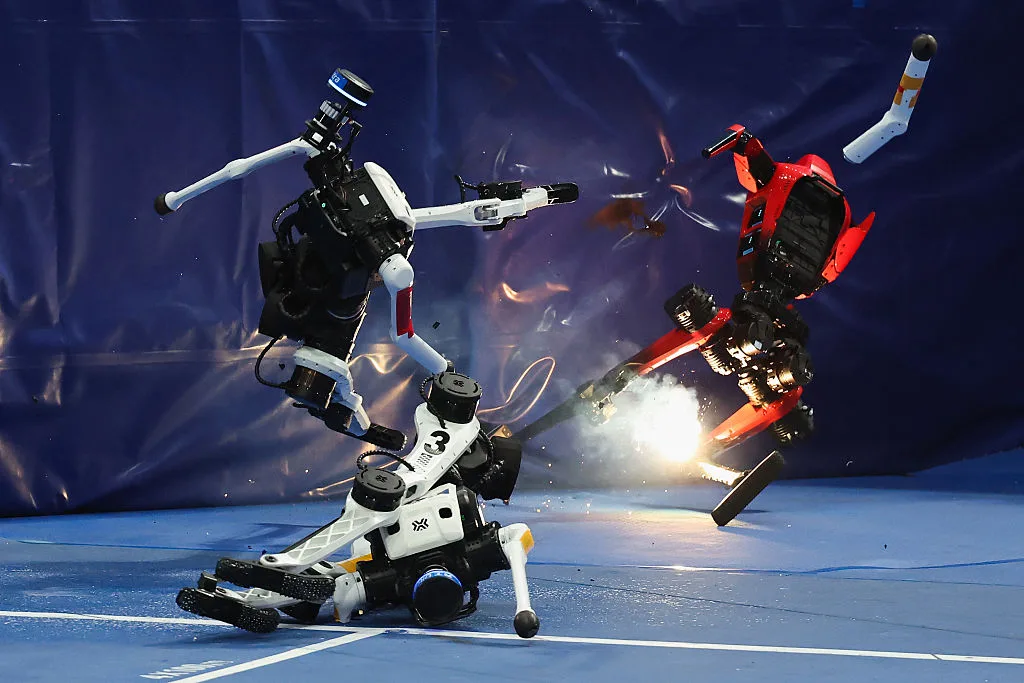
A humanoid robot collided with an obstacle and caught fire at the end of the 100 meter race during the 2nd World Humanoid Robot Games on Aug.
25, 2026. —Lintao Zhang—Getty Images When Tiangong Ultra unofficially smashed Usain Bolt’s 100m world record in Beijing, China, unballetically flailing past the finish line in 8.86 seconds, he did not flash an Olympian grin down the camera lens.
In fact, he has no face.
He is a headless robot.
Ultra, the work of the Beijing Humanoid Robot Innovation Center , was competing in the penultimate day of the unapologetically dystopian World Humanoid Robot Games , which has been hosting 666 teams at China’s National Speed Skating Oval.
At this event, more than 2,000 robots are put to the test in track and field events (like long jump and an obstacle course); sports (like table tennis and soccer); and “scenarios” (like bricklaying and firefighting).
The event produced several eye-catching moments, including when humanoids beat human records at the high jump and the 400m.
Just a few days before Ultra’s race, Lightning, a robot developed by phone company Honor, ran the 100m in 9.39 seconds, again thundering home quicker than Bolt .
But these tumbling records will likely be, in the pop cultural consciousness, eclipsed by something far more entertaining: tumbling robots.
Along with the epic wins, there have been some seriously old-school, epic fails.
One humanoid at the weightlifting event lost its balance with a weedy 15kg barbell, started jerking and slammed into the judges’ table, its helpless arms aloft, as if to say, “Why me?” Most memorably, a robot ended his dash by careering into a safety mat, Tom and Jerry style, before cartoonishly arching backward and setting on fire .
Each spark was like a beautiful firework.
These slapstick scenes are deliciously satisfying.
It’s deeply reassuring to watch robots fizzle out into smithereens.
5News aggregated this summary from the outlet’s public feed. The full article, with all the context, is on time.com — the content belongs to TIME.