This ‘Little Planet’ Is a Surreal Record of How We’ve Changed Nature—and It’s a Photography Contest Winner
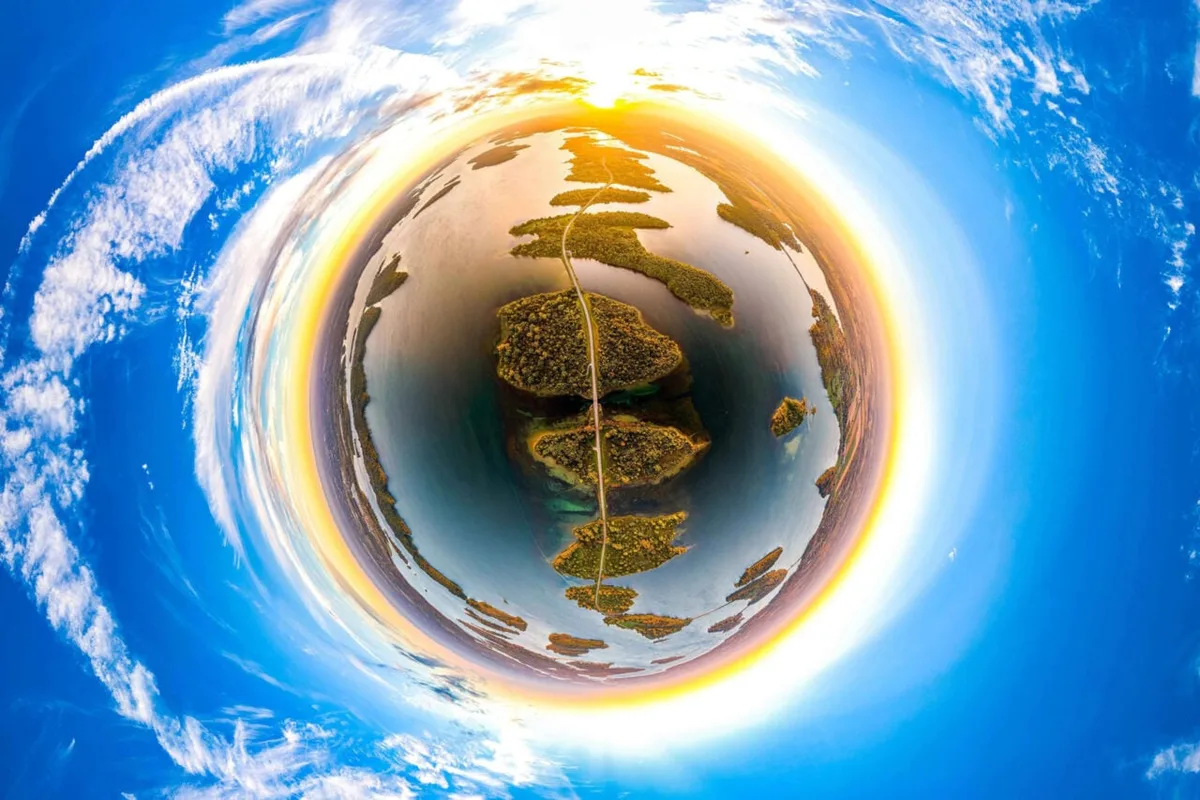
This mesmerizing image is a stereographic projection of the Long Sault Parkway, a bridge linking 11 islands in Lake St. Lawrence, Canada. Allan Tian, a postdoctoral researcher with Queen’s University in Canada and Hangzhou Normal University and Zhejiang University in China, captured the image while conducting biodiversity research at the lake.
“The creation of this waterway caused severe fragmentation of historically interconnected aquatic ecosystems and displaced thousands of residents,” Tian said after winning the “Protecting our planet” category in this year’s joint BMC Ecology and Evolution and BMC Zoology image competition . “Today, the parkway serves as a bridge between the disruptions of the past and present conservation efforts.”
The contest, hosted by the two journals, showcases the “beauty and diversity of nature,” as well as the “remarkable efforts of scientists to understand and protect it.”
The gallery— which you can check out here —celebrates the beauty of nature, specifically seen from the perspective of the scientists who study it. Read on for Gizmodo’s favorites from the list.
To start, here’s the overall winner of the competition: a bobble-eyed damselfly peering through a hole in the leaf. Sritam Kumar Sethy, a student at Berhampur University in India, captured this photo at a freshwater wetland habitat in Odisha, India.
The damselfly’s adorable little face betrays the fact that, in its habitat, the insect is a key predator that regulates insect populations in wetlands. In his winning statement, Kumar Sethy explained that damselflies are bioindicators of ecosystem health, particularly in wetlands—an increasingly disappearing, threatened habitat.
Australia is somewhat famous for being home to Earth’s weirdest, wildest creatures. That includes the giant Australian cuttlefish in this photograph, which won the category for relationships in nature. Victor Huertas, a researcher at James Cook University in Australia, took this image of male cuttlefish locked in a battle to impress a potential mate.
“This image freezes an ancient contest, one repeated for millennia in these waters alone and increasingly vulnerable to a changing ocean,” Huertas said in his winning comment. “Yet even aggregations of this scale are not invincible; reports this season point to unusually low numbers gathering in the area, a sobering sign of how fragile even large-scale natural phenomena can be.”
This photograph depicts a dramatic instance of mobbing—an anti-predator strategy in birds, in which smaller species (friarbirds, right) come together to harass a potential threat (the raptor on the left). Alwin Hardenbol, a postdoctoral researcher at the Natural Resources Institute Finland, won runner-up in the category for relationships in nature.
“Three birds hang in the air like charcoal smudges on white paper,” commented Christy Hipsley, a member of the judging panel. “Once our brain processes that this is a black and white photograph and not a drawing, the next striking feature is the action of this moment.”
In this image, three Florida manatees bustle up against the edge of a freshwater drain in Everglades National Park.
5News aggregated this summary from the outlet’s public feed. The full article, with all the context, is on gizmodo.com — the content belongs to Gizmodo.