Sunken WWII hospital ship colonized by devil firefish and rare monk seals
A sunken World War II hospital ship off the coast of Albania has attracted both invasive devil firefish and rare Mediterranean monk seals, leading researchers to weigh the risks and benefits of these wrecks for local ecosystems.
The ship, called the Po, sank off Vlora Bay in 1941 after being hit by a torpedo from a British Fairey Swordfish aircraft during the Greco-Italian War, one of the conflicts within World War II.
It is now acting as an artificial reef, with over 80% of its surface teeming with marine life, researchers reported July 27 in the journal Frontiers in Ocean Sustainability .
This phenomenon, by which submerged structures attract marine life, is called the artificial reef effect, and it occurs when marine life colonizes a newly introduced solid structure underwater.
These structures can provide shelter because crevices and dens serve as hiding places, as well as food from the algae and other organisms that grow on its surface.
While there has been research on Vlora Bay generally, there was no historical biological or quantitative data for the Po wreck itself.
The study was conducted to find out more about how its structure affected the surrounding seabed and how marine organisms have colonised.
While there has been research on Vlora Bay generally, there was no historical biological or quantitative data for the Po wreck itself.
The new study sought to find out more about how the ship's structure affected the surrounding seabed and how marine organisms have colonized it.
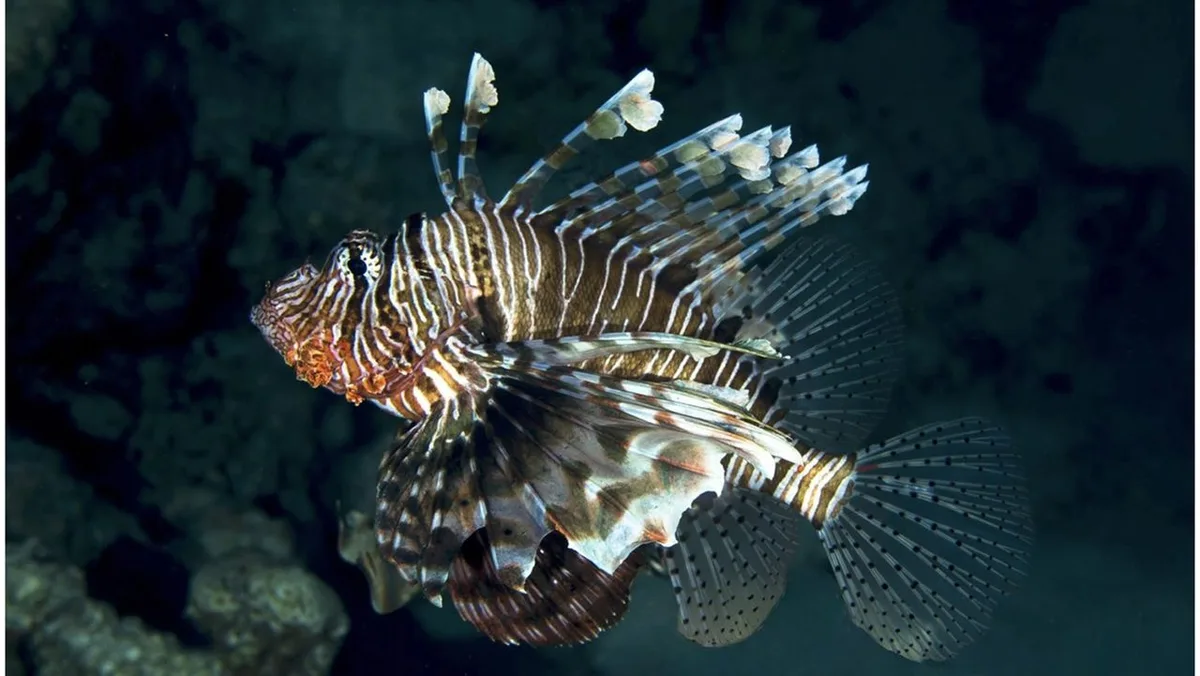
Devil firefish ( Pterois miles ) are native to warm coastal waters and coral reefs of the West Indian Ocean and the Red Sea.
However, the new study found these fish swimming around the shipwreck off the coast of Albania, around 800 miles (1,300 kilometres) away, between June 2022 and September 2024, with up to seven individuals observed simultaneously.
The study authors suggested that shipwrecks like Po could be attracting these invasive animals from their natural habitat toward more temperate waters.
“Unfortunately, I can't call it a true scientific surprise, because the effects of climate change are now sadly well known and predictable," Simone Modugno , a biologist and scientific diver at the University of Ferrara in Italy and co-author of the study, told Live Science.
"What's perhaps most surprising is the speed with which these climate changes are occurring, acting as a driver and amplifier for the incursions of tropical and alien organisms.
5News aggregated this summary from the outlet’s public feed. The full article, with all the context, is on www.livescience.com — the content belongs to Live Science.