U.S. economy hits pivotal milestone: Spending on data centers and other information-processing hardware now exceeds housing investment

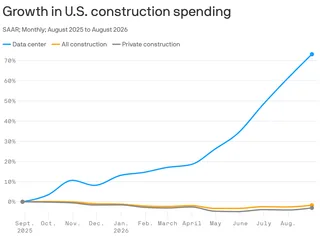
Two decades after the housing boom reshaped, then tanked, the U.S. economy, the AI boom is similarly transforming the drivers of growth.
Hyperscalers have poured so much money into building as much AI infrastructure as possible—and as quickly as possible—that investment from a handful of companies is expected to reach $1 trillion a year soon.
Meanwhile, the housing market has been largely frozen since the COVID-era boom ended in 2022, when the Federal Reserve embarked on an aggressive rate-hiking campaign to rein in inflation.
“We’re seeing a pivotal shift in the US economy: investment is shifting away from residential investment and towards computers,” Adam Shapiro, vice president at the San Francisco Fed, posted on LinkedIn recently.
He pointed out that inflation-adjusted spending on information processing equipment, which includes data centers and computer hardware, now exceeds residential investment.
According to data from the Bureau of Economic Analysis, real private residential fixed investment was $748 billion in the second quarter, down 18% from an early 2021 peak.
During that same span, spending on information processing equipment has soared 51% to $752 billion.
“The AI investment boom is massive,” Shapiro added.
He also noted that residential investment is more sensitive to borrowing costs, which have gone up alongside Treasury yields.
The benchmark 30-year mortgage rate is nearly 7% as the 10-year bond yield has hit the highest level since 2007.
By contrast, AI investment has been less sensitive to interest rates, even as hyperscalers have started issuing more debt to supplement drawdowns of their cash piles.
Google parent Alphabet , for example, even reported negative cash flow earlier this year.
Treasury Secretary Scott Bessent has also highlighted the eagerness with which AI companies are offering debt—no matter the cost of borrowing.
“We are also seeing big corporate issuance.
5News aggregated this summary from the outlet’s public feed. The full article, with all the context, is on fortune.com — the content belongs to Fortune.