ICE uses controversial program to boost deportations. Here's how it works in 1 county
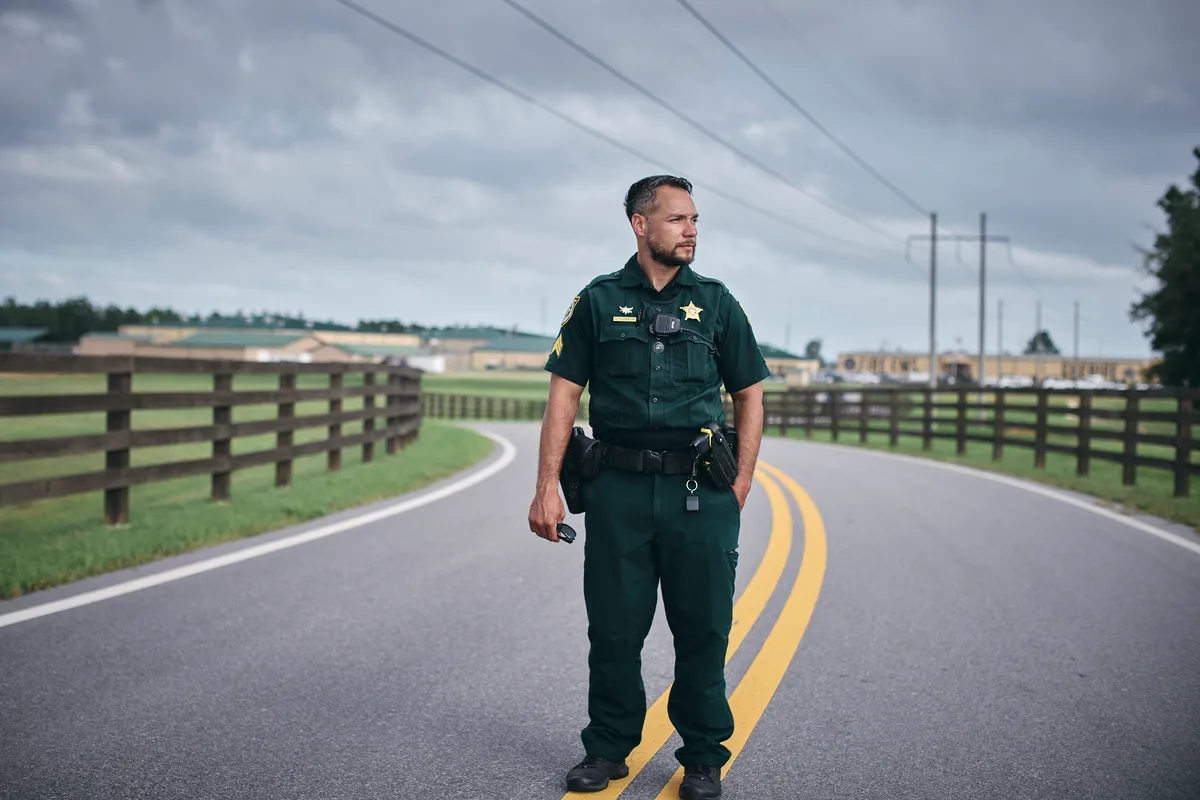
Walton County Sheriff's Office Sgt. Oscar D'Lassalas, 40, an officer certified to enforce federal immigration law, stands on the road to the jail where undocumented people are held for federal Immigration and Customs Enforcement agents to pick up. The sheriff's office in this Florida Panhandle city has partnered with ICE. Nicky Quamina-Woo for NPR hide caption
"I got four boys and a girl living with me. The baby's going to be 3 in December. She runs the house," he says with a laugh.
Photos of his wife and children are pinned above the driver's seat of his sheriff's office-issued vehicle, which is packed with rifles, a fire extinguisher and bulletproof vests.
D'Lassalas, 40, is a sergeant with the Walton County Sheriff's Office in Florida. He also leads the office's SWAT team. Last year, he became a certified 287(g) task force officer, which allows him to enforce certain parts of federal immigration law in the field.
The sergeant completed 40 hours of training online to get certified. The Trump administration recently accelerated the training , which used to require a monthlong in-person commitment, as it sought to expand the number of law enforcement agencies participating in the 287(g) program.
"To me, it was just another way to help out as much as I can in my community," D'Lassalas says.
The Trump administration has embraced the 287(g) program as a way to boost its mass deportation effort. It's a controversial program that has led to civil rights lawsuits alleging racial profiling and complaints that it drains local resources.
The interior of D'Lassalas' SUV, on the road to the jail where undocumented people are held for ICE agents to pick up. Nicky Quamina-Woo for NPR hide caption
In this fast-growing Florida Panhandle community — a county heavily reliant on immigrant labor for construction and tourism — the sheriff's office insists its role in the program is narrowly focused.
"We're certainly not out doing immigration raids. That's not what we do," Walton County Sheriff Michael Adkinson says. "But if we come across those individuals who are committing a crime or endangering someone else, in the state of Florida, then we're certainly going to do that."
The 287(g) program has been around for 30 years. It has been used in Democratic and Republican administrations to varying degrees. But the Trump administration has significantly expanded it.
Under a task force agreement, a version of 287(g) that Walton County signed onto last year, officers are deputized to perform specific types of immigration enforcement in the field. This can include interrogating someone suspected of being in the U.S. illegally, collecting evidence or making immigration arrests.
Sam Lester, an immigrant rights attorney with the ACLU (American Civil Liberties Union) of Florida, says immigration enforcement in the state is different from the aggressive and very visible operations seen elsewhere.
La Guerrerense is a common hangout and family-owned shop that features Mexican groceries and ready-to-eat dishes in downtown DeFuniak Springs, Florida.
5News aggregated this summary from the outlet’s public feed. The full article, with all the context, is on www.npr.org — the content belongs to NPR.