Willem de Kooning Ripped Up the Rules of Drawing
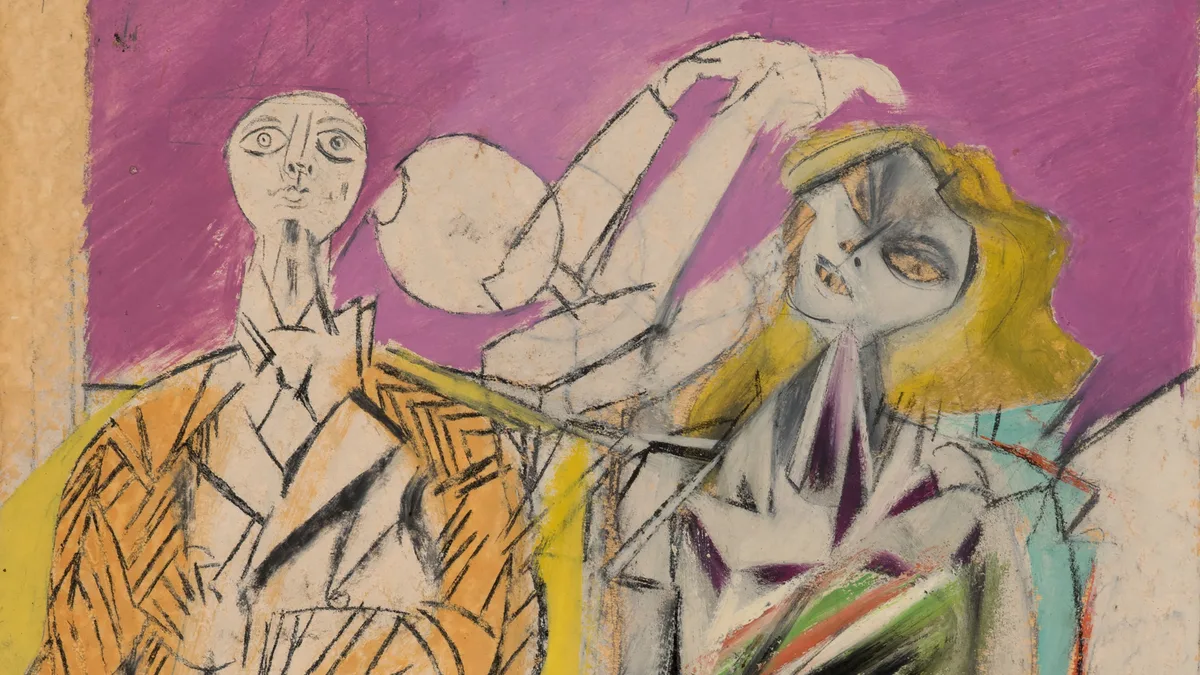
Most retrospectives unfold like a stately procession.
You buy your ticket and proceed through a choreographed sequence of galleries, scrutinizing first the juvenilia, then the promising early work.
Next come the triumphal years, and finally (if the artist was lucky) a poignant late phase.
An idea of timelessness prevails, enhanced by an enveloping atmosphere of climate control, security, and massive insurance coverage.
The lighting is good; the frames are tasteful.
Everything looks marvelous.
There’s not a whiff of the urgency of the studio, no hint of the emotional or psychological state in which these objects were made.
Lost is any suggestion of that feeling, deep inside the creator, of an improvised, inner necessity.
“Willem de Kooning Drawing,” at the Art Institute of Chicago, is a classic retrospective—a decorous, deeply researched exhibition about a much-lauded artist at a major museum.
In another, more robust sense, however, the show is a giant debauch.
It’s frankly (and thrillingly) unseemly.
I’ve never been to an art show that takes you so far inside the creative process.
You start to wonder if you should even be permitted to get so close.
Photo by Harry Bowden Willem de Kooning sitting with charcoal drawings scattered on the floor in his studio at 85 Fourth Avenue, New York, 1946.
5News aggregated this summary from the outlet’s public feed. The full article, with all the context, is on www.theatlantic.com — the content belongs to The Atlantic.