Scientists create 'laundry gun' for astronauts to clean their clothes by shooting out plasma
If you have ever shared a room with multiple people for days on end, you may know how clothes and living conditions can rapidly turn rather smelly.
Imagine that happening in a confined spacecraft.
Even worse, since water on a space mission is in short supply, space travelers can't easily do their laundry.
This is more than a body odor problem — unclean clothes and linens are ripe feeding grounds for infectious bacteria.
Astronauts might wear the same clothes for days or even weeks, seal away used clothes in airtight bags , then return them to Earth for cleaning or cast them away to burn up in Earth's atmosphere.
This is fine for short trips near Earth, but what about a months-long odyssey to Mars ? Engineers have devised a new way for astronauts to dry-clean their dirty laundry.
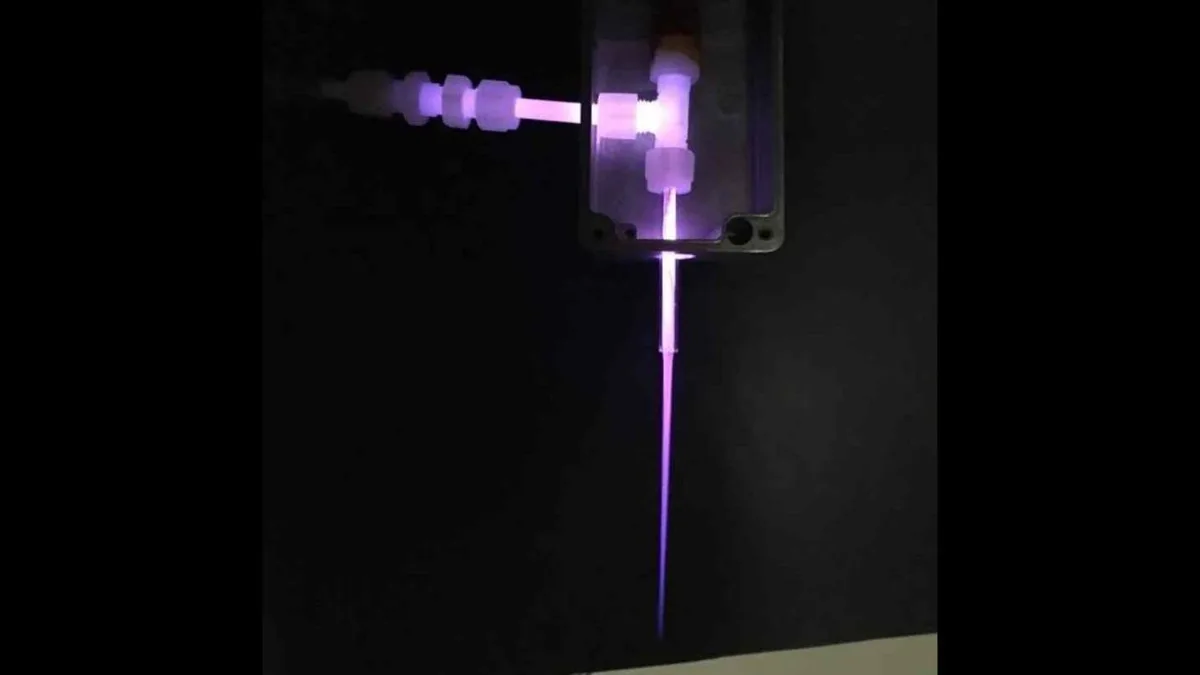
They've crafted a prototype "laundry gun" that sterilizes fabric by shooting violet-colored plasma into it.
"This will reduce the microbial load and keep clothes and other soft surfaces clean, at least microbially, for astronaut health," says Gabe Xu, a professor at the University of Alabama in Huntsville and one of the laundry gun's creators, in a statement .
"It could also be used to sterilize space suits and tools before they leave the habitat and step foot on Mars." A plasma is an energized soup of charged particles, ions and electrons.
While many plasmas like that in the sun are very hot, the laundry gun's plasma is "cold," closer to room temperature.
Its electrons are key to killing bacteria.
As the laundry gun shoots plasma into fabric, the electrons collide with gas molecules in the surrounding air, such as oxygen (O2) and water vapor (H2O).
These collisions create other molecules like ozone (O3), which chemists call "oxidizing species".
These oxidizing species can chemically react with the membrane that surrounds a bacterium, damaging and destroying it.
5News aggregated this summary from the outlet’s public feed. The full article, with all the context, is on www.space.com — the content belongs to Space.com.