Researchers Say They’ve Found the Truth About Thomas Jefferson
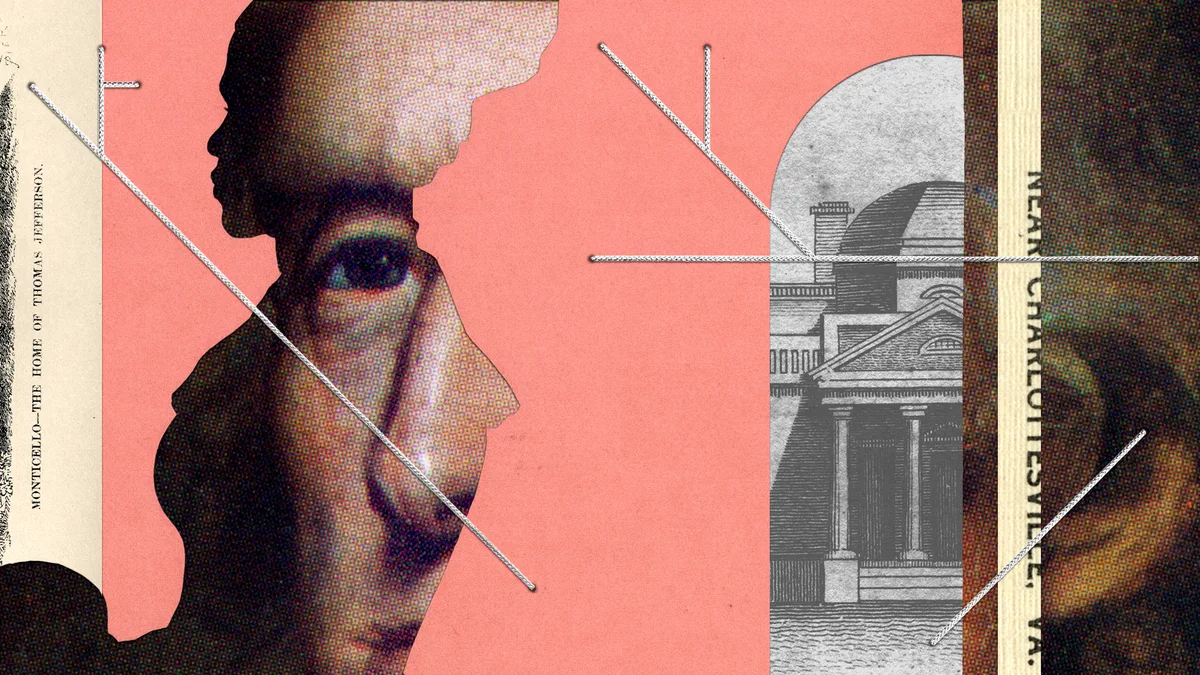
T hree hours after Thomas Jefferson died at his Monticello home on July 4, 1826, his personal secretary, Nicholas Trist, snipped a lock of the Founder’s gray hair, still faintly reddish blond.
Trist then tied the hair with orange thread and placed it in a paper packet, along with a short note describing what he’d done.
In an era before photography or modern embalming, hair was an easily preserved reminder of a beloved friend or relative who’d died.
Trist did not know that he was also securing physical evidence that, two centuries later, would help resolve one of the nation’s oldest and most contentious historical debates: whether the author of the Declaration of Independence, the nation’s third president, had children with Sally Hemings, a woman he enslaved for half a century and never freed.
After a covert and exhaustive 15-year effort led by the Smithsonian Institution, a team of geneticists, genealogists, historians, and anthropologists believe it has found proof that Jefferson fathered at least two of Hemings’s six children.
On Tuesday, Richard Kurin, a Smithsonian cultural anthropologist, who led the multidisciplinary research effort, will publish a book detailing the team’s findings.
A scientific paper is currently under review for publication in Proceedings of the National Academy of Sciences ( PNAS ).
The researchers, who agreed to speak with me about their results before publication, relied on the latest genetic techniques to reassemble Jefferson’s genome from the Founder’s hair.
They then matched that sequence with DNA from descendants of two of Hemings’s sons, Madison and Eston. (Of her other four children, two died in infancy, and the other two didn’t have any known offspring.) Not only did the researchers find that Madison’s and Eston’s descendants share Jefferson’s DNA; many of them had more of it than do his known descendants by way of his wife, Martha Wayles. [ Read: When slavery is erased from plantations ] For many Americans, the matter was already laid to rest years ago.
In 1998, the scientific journal Nature published a two-page peer-reviewed paper titled “Jefferson Fathered Slave’s Last Child.” Newspaper stories declared the case solved, and Oprah Winfrey staged a tearful family reunion of Jefferson’s descendants.
Most historians came to accept the finding when it was combined with other evidence from the era.
But a vocal minority has continued to doubt that the two had a sexual relationship.
Some have pointed out, correctly, that the limited biological data used in the Nature study did not definitively prove that Jefferson was the father of Hemings’s children—only that he was one of several candidates in the Jefferson male line.
5News aggregated this summary from the outlet’s public feed. The full article, with all the context, is on www.theatlantic.com — the content belongs to The Atlantic.