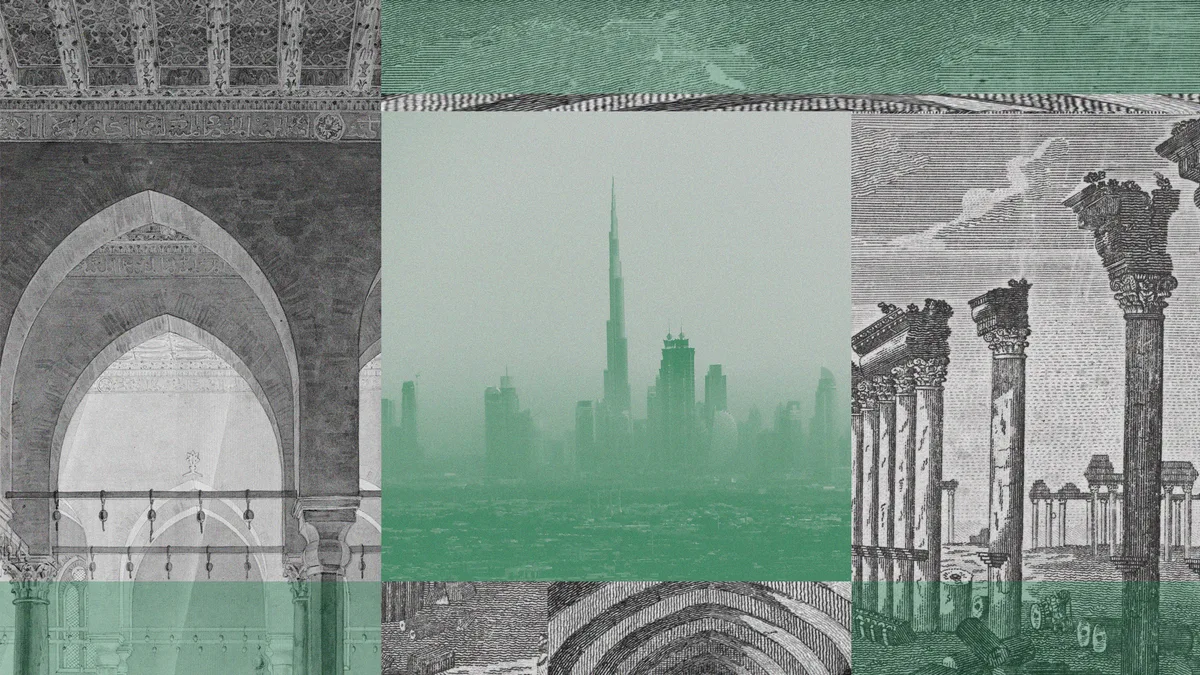
The Middle East Still to Come
“My love is not for places or for lands.
My only passion is for the lightning flash,” wrote Ibn Arabi, a philosopher who in 1200 C.E. set out to travel across the war-torn chaos we now call the Middle East.
Ibn Arabi’s reaction to the conflicts, fanaticisms, and hatreds of his time was to develop an idea he called “The Absolute”— Wahdat al-wujud , or the unity of being—which combined his own Sufi Islam with other faiths and dreams with such a generosity of spirit that his critics accused him of heterodoxy and heresy.
His ideas were complex and often obscure, but today they seem startlingly modern, tolerant, and hopeful.
Journeying from his native kingdom of Murcia, in Islamic Spain, through a Maghreb ruled by revivalist conquerors called the Almohads, to Cairo, Mecca, and Damascus, Ibn Arabi judged people by their worth, not their identity, and ideas by their value, not their origin.
Now as then, the Middle East is a region where wars destroy people, places and civilizations, yet also give rise to auspicious conjunctions and technical ingenuities.
As Abu Tamman ibn Aws wrote in his “Ode on the Conquest of Amorium” in 838 C.E., “knowledge sparkles on the tips of lances.” In today’s hurtling, interconnected world, wars are fought in arenas that did not exist just 20 years ago—not only battlefields of men and heavy metal but multiple echelons, some high tech, digital, multimedia, and even intergalactic, others distant, indirect, and improvised, guerrilla-style.
Neat triumphs do not come often, and when they do, they are as transient as the apogees of empires.
The consoling superiority of military ingenuity is short-lived: The other side always catches up fast, and many new technologies empower the weaker party against the mighty, granting brave resisters survival and even victory.
In what I call iPhone-and-dagger societies, berobed warriors in Toyota pickups can use game consoles to direct drones that doom gleaming million-dollar fighter jets—and may one day sink an aircraft carrier.
In the past quarter century, one of the most important changes in the region has been the rise within it of new great or median powers willing to manipulate the legacy of the European imperial powers that ruled before 1945, and to defy or challenge the superpowers that dominated during the Cold War.
The United States, Russia, and China still intervene in the Middle East, but in a manner that is Olympian, erratic, and inconsistent.
Behind them lurks a deeper conflict of entire systems: the open world, still (just) led by America, versus the closed world that is the axis of China and Russia.
A parallel, simultaneous battle, centered within the Middle East, rages among different versions of, or attitudes toward, the practice of Islam and its complex relationship with the West.
5News aggregated this summary from the outlet’s public feed. The full article, with all the context, is on www.theatlantic.com — the content belongs to The Atlantic.