The Breakout Music Video of the Year Has a Message for Men. What Is It?
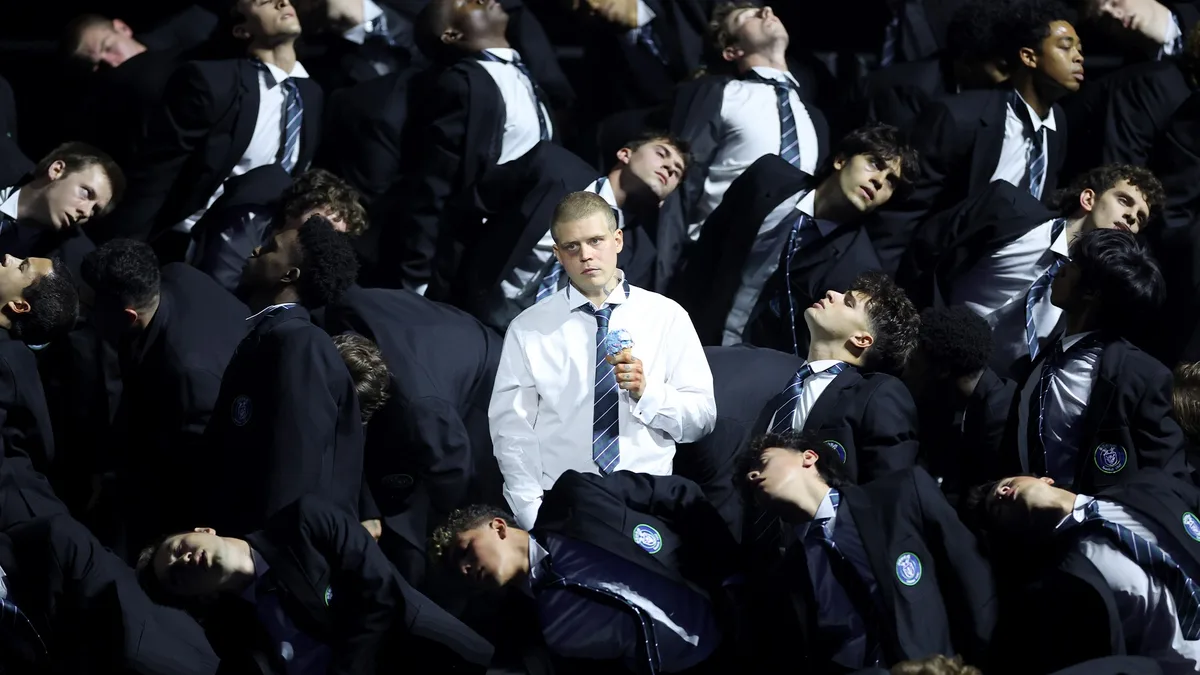
As an alarm siren cried out, the 30-year-old Swedish rapper Yung Lean rushed to the stage of the MTV Video Music Awards last month, looking furious.
His button-up shirt was spotted with what appeared to be blood; he smashed a chair on the floor, broke a Moon Person trophy, and took his place in the middle of 66 young men wearing ties, blazers, and blank looks on their faces.
Then those men around him did something odd.
They started dancing—in pulsating, fluid movements as hypnotically beautiful as a leaping pod of dolphins.
This was a live rendition of part of the most discussed music video of the year: “Storm,” by Gener8ion, a previously obscure collaboration between the French electronic musician Surkin and the French filmmaker Romain Gavras.
The music features Lean warbling hoarsely over propulsive beats, and the video features him as a bully dominating his classmates.
But the centerpiece dance sequence of the seven-and-a-half-minute clip is what attracted attention upon the song’s release, in April.
“Storm” now has more than 34 million YouTube views, an eye-popping number at a time when music videos rarely reach anyone but an artist’s fans.
TikTok and Instagram are full of people—kids, dancers, athletes, farmers, wedding guests—stomping and swaying like (but never as impressively as) the video’s boys.
The phenomenon has sparked a mystery: What does the dance mean? Set at a U.K. school in the year 2034, the “Storm” video fuses subtle sci-fi into a familiar tale of adolescence.
At one point, Yung Lean’s character tears down a 6G cell tower and smokes metal shavings from the wreckage in a glass pipe.
Lord of the Flies , American History X , and other cultural depictions of male bonding through brutality may come to mind for viewers.
Some commenters have called “Storm” a celebration of masculine energy; others say that it subverts that very thing by showing boys diverting aggression into expressive movement.
On Sunday, I spoke with Damien Jalet, the choreographer who came up with the dance, and his interpretation was decisive: The point was to convey vulnerability—specifically, “male vulnerability.” Jalet wanted to show the soft interiority of boys under “pressure”; one of the topics he and Gavras discussed was the anxiety of attending school in an era when active-shooter drills are a reality.
5News aggregated this summary from the outlet’s public feed. The full article, with all the context, is on www.theatlantic.com — the content belongs to The Atlantic.