Let’s Celebrate the Supreme Court Not Outright Rigging the 2026 Election
There are two ways of looking at the Supreme Court’s three-sentence ruling in USPS v. California Monday evening that put an end to Donald Trump’s attempt to disenfranchise millions of elderly, disabled, military, rural, Native American and other voters in the 2026 midterm elections who depend upon vote by mail as their only viable option to cast a ballot. The first is to lament that the government pushed this case to the limits—going not once or twice, but three times to the Supreme Court—and that two Justices, Samuel Alito and Clarence Thomas were willing to simply ignore mass disenfranchisement and side with Donald Trump’s bogus voter fraud crusade. The second is to note that the court’s conservatives and liberals came to the brink, saw that ruling the other way risked serious election subversion, and said “No.” For the time being, let’s celebrate that the center of the court did hold, even as dangers remain ahead in both 2026 and 2028.
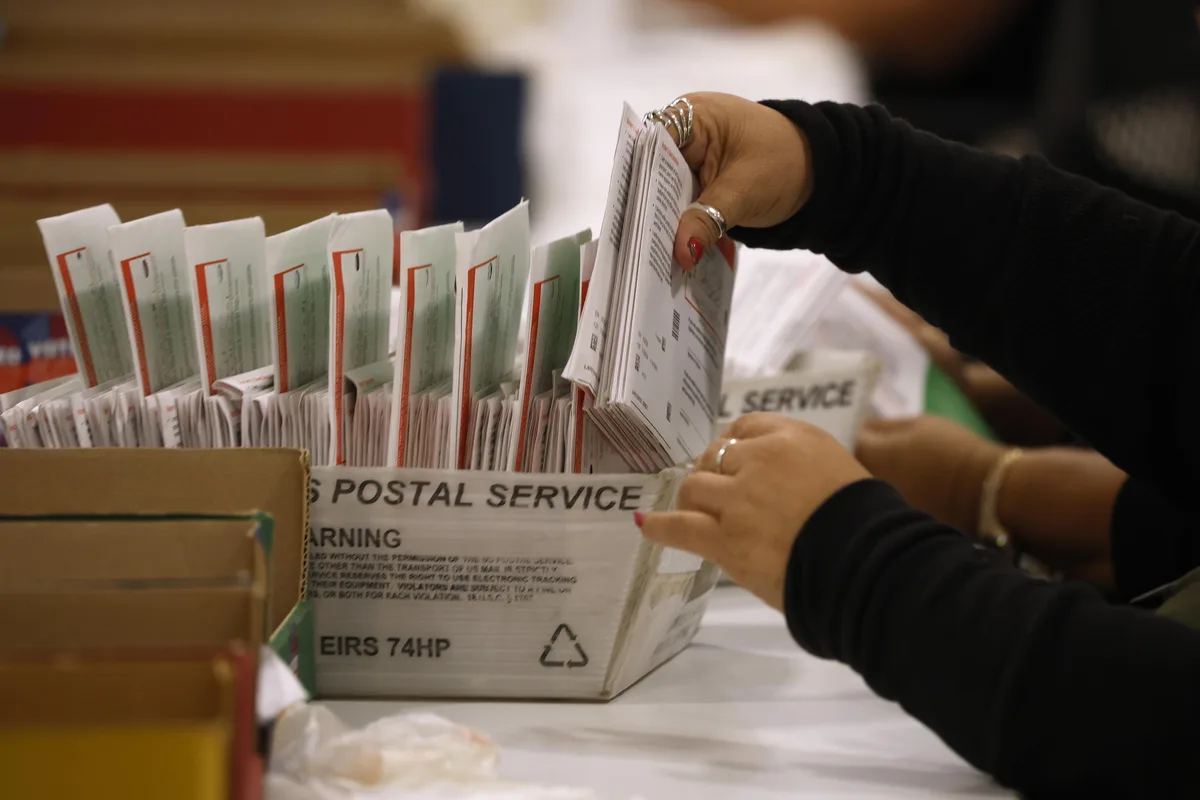
Slate readers are already familiar with this long saga, so just a very brief review is necessary. Back in March, President Trump put out an executive order on voting (his second since returning to office in 2025) that among other things directed the post office set up a new rule imposing a set of requirements for states that wanted to continue to have their ballots delivered by mail. USPS’s rule issued in late August required that states get USPS approval for new envelope designs with intelligent bar codes on them, to put those bar codes on each envelope, upload a list of the state’s voters to a USPS portal, and to submit the ballots for the post office to check the names encoded in the bar codes against the voter list. The rule further required the USPS to reject an entire batch of ballots if there was one potential mismatch. In the brief moment when courts did not block the rule from going into effect, USPS rejected Leon County, Florida’s ballot design because its required printed notation about return mail was 0.014 of an inch too close to other information on the envelope.
Now complying with all these new rules sounds pretty hard for election administrators to do with lead time and practice. But the government tried to impose these rules for the already ongoing midterm elections. Envelopes have already been loaded with ballots and addressed. Indeed, North Carolina began mailing ballots on September 4, and other states are doing so now. Even as of Monday’s Supreme Court’s ruling, USPS did not have a working portal for states to upload their voter lists, not even on a voluntary basis as USPS had said would be possible by last week.
The upshot of USPS’s administrative failure is that the rule would have stopped the agency from accepting ballots from all states because there could be no matching between the envelope and the portal. That means that the most vulnerable voters who depend on vote by mail around the country would have been disenfranchised, including core Republican constituencies.
The federal district court issued a preliminary injunction partly on this basis, noting the burdens on election administrators were high and the public interest costs dire.
5News aggregated this summary from the outlet’s public feed. The full article, with all the context, is on slate.com — the content belongs to Slate.