‘The great quantum migration’ is coming as more than $2 trillion in digital assets is at risk—nearly the entire value of the overall crypto market
Watch out crypto-bros—it might be time to start moving assets.
Researchers are making progress toward quantum computers powerful enough to undermine the mathematical assumptions that currently protect cryptocurrency and other blockchain-based assets.
Because of this, the industry needs to replace its cryptographic infrastructure before the quantum computers arrive.
“The great quantum migration is going to require the entire digital asset industry to participate,” Christopher Smith, co-founder and CEO of Quantus, a quantum-secure blockchain network.
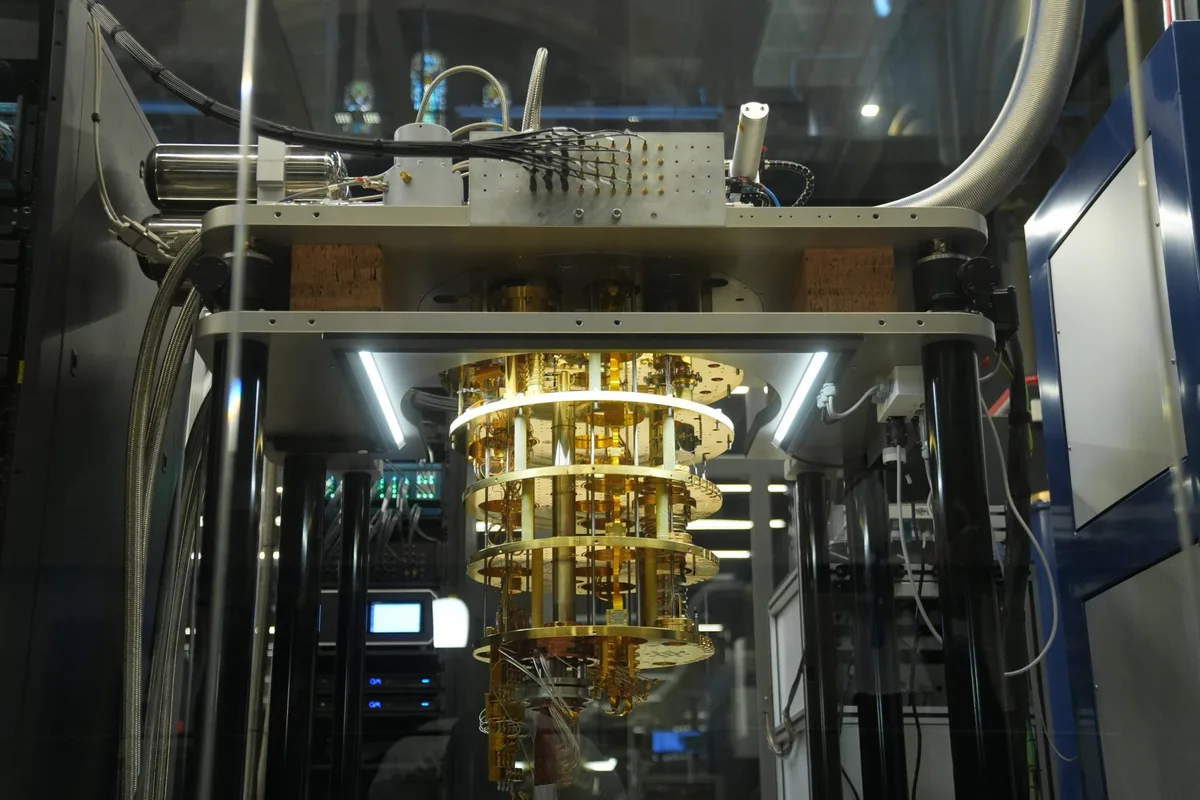
Quantum computing is a fundamentally different approach to processing information.
Traditional computers use bits represented as either 0 or 1, and are physically constrained by how tiny transistors can be miniaturized.
Quantum computers use subatomic particles and trapped ions to crunch numbers via qubits—allowing the machines to theoretically perform any calculation in a fraction of the time it would take today’s technology.
Until recently, the cryptography that proves ownership of digital assets was considered essentially unbreakable.
That’s because today’s classical computers would take too long to feasibly perform the calculations needed for gaining access to a so-called private key that authorizes transactions.
According to reports , a standard supercomputer would take hundreds of millions of years to break a cryptography code.
But a sufficiently powerful quantum computer can change that, Smith warned.
“Over $2 trillion in digital assets is secured by elliptic curve cryptography, which has been known to be quantum-vulnerable for over 30 years,” he said.
That’s nearly the entire overall crypto market, which is worth $2.16 trillion.
The threat from quantum computing may be getting closer, and Smith pointed out that AI is being used to accelerate quantum research.
5News aggregated this summary from the outlet’s public feed. The full article, with all the context, is on fortune.com — the content belongs to Fortune.