Scientists discover massive 'thermal anomaly' beneath the surface of Mars
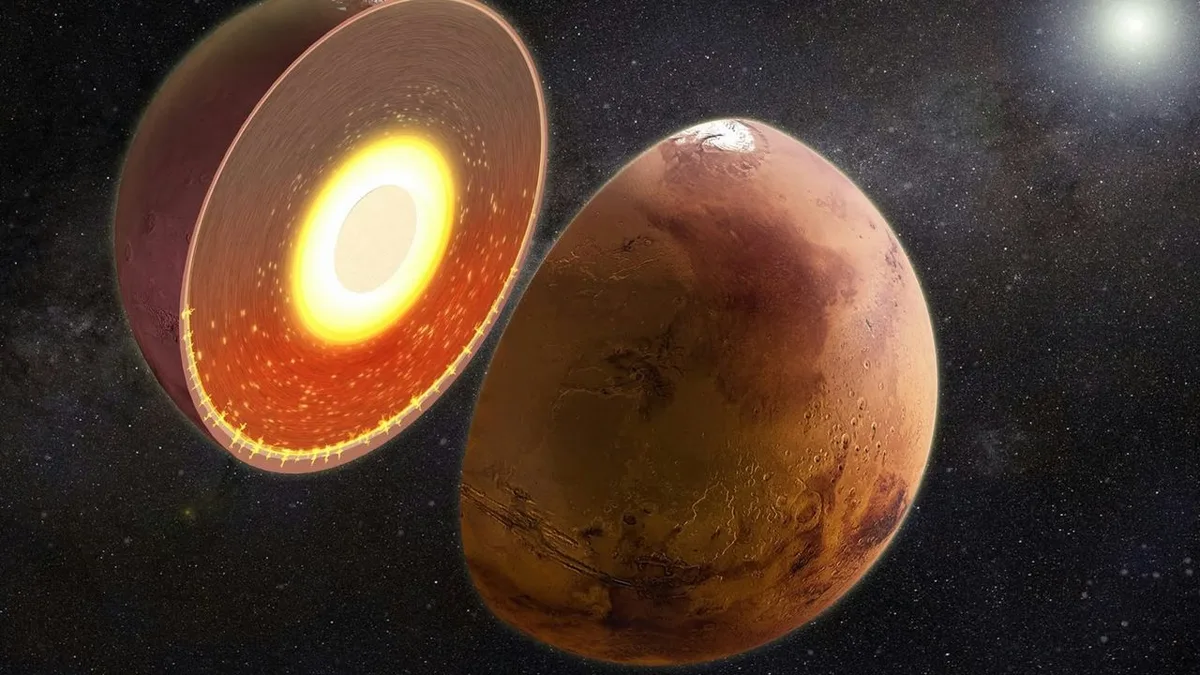
New research into the interior of Mars further emphasizes that the Red Planet is a world of two very different halves.
Deep inside the southern hemisphere of Mars , the temperature is up to 750 degrees Fahrenheit (400 degrees Celsius) warmer than beneath the northern hemisphere, deepening the mystery of the strange dichotomy between the Red Planet's flattened north and craggy southern highlands .
"Scientists usually assume that the interiors of planetary bodies are generally spherically symmetric, but this is not necessarily true," said Alexander Berne, formerly of Caltech and now at the University of Arizona, in a statement .
Berne is the lead author of a new research paper revealing the discovery of the strange southern hotspot.
Berne and his team went back and looked at archival data from three NASA spacecraft – Mars Global Surveyor, Mars Odyssey and Mars Reconnaissance Orbiter – to look for subtle changes in their orbital velocity that might reflect variations in Mars 's gravitational field.
Using a technique developed by Berne called 'tidal tomography' that also accounts for the sun 's varying gravitational influence on Mars as the Red Planet progresses around its elliptical orbit, he and his team were able to infer a model of the interior structure and temperature of Mars.
How the gravitational field that the various spacecraft experienced changed over time differs substantially from what would be expected were Mars's interior perfectly spherically symmetrical.
To explain this difference, the mantle beneath Mars's southern hemisphere must be between 390 and 750 degrees Fahrenheit (200 and 400 degrees Celsius) warmer than the mantle in the north, and indeed it is so warm that it could still be partially molten.
This could have repercussions for both Mars's habitability and how long Mars remained volcanically active.
Perhaps we shouldn't be surprised that Mars's interior is different in the south compared to the north, because we already know that its surface is asymmetrical.
The north of Mars is characterized by lowland plains, while the planet's crust in the south is on average 15.5 miles (25 kilometers) thicker than in the north and is covered by cratered highlands.
The northern lowlands may have once been home to a large ocean .
"The dichotomy that we see between north and south is important to understand because it gives information about processes that may have influenced the hydrology of Mars, including the formation of basins that may have held water," said Caltech's Amirhossein Bagheri, who is the second author of the research.
A bird's-eye view of wind-blown dunes in Kaiser Crater, a 129-mile-wide (207-kilometer-wide) impact basin in Mars' southern highlands.
5News aggregated this summary from the outlet’s public feed. The full article, with all the context, is on www.space.com — the content belongs to Space.com.