Nvidia’s AI advantage is moving beyond the GPU
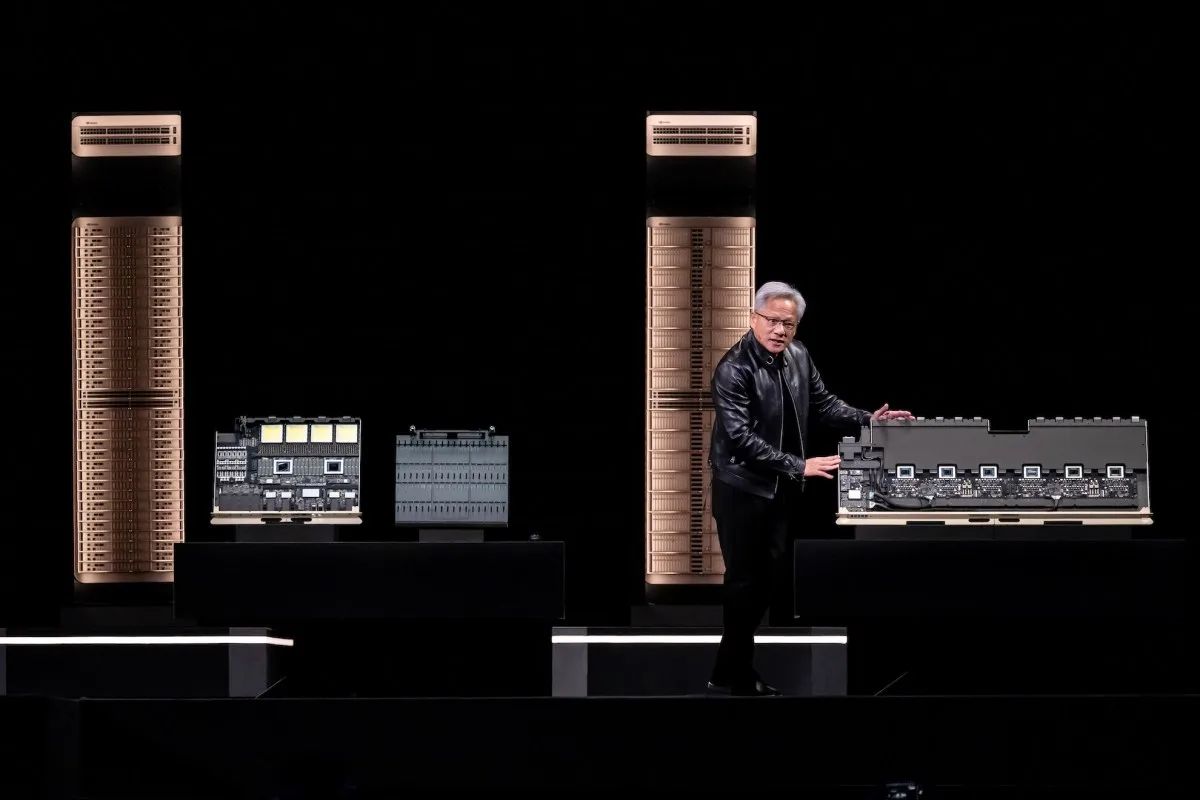
Before this week, the dominant story about Nvidia went something like this: For the first few years of the AI boom, Nvidia was the only source for state-of-the-art GPUs, which became immensely profitable as the industry scaled out. In the last few years, hyperscalers like Amazon and Google have started building their own chips, and Nvidia is no longer the only game in town, leading many investors to wonder how durable its advantage really is.
It’s a compelling story, and mostly true. After growing its market cap 10x between the start of 2023 and mid-2025, Nvidia shares have been on a more modest trajectory for the past year, driven by concerns about GPU competition.
A new narrative has taken shape since the company’s earnings on Wednesday and investors are starting to realize that Nvidia’s advantage goes far beyond GPUs. As AI’s compute grows into the gigawatt scale, orchestration has become an increasingly complex task. Not surprisingly, Nvidia has built much of the state-of-the-art hardware needed to handle it, giving the company a huge advantage in the systems that surround the GPU even as it sees increased competition on the GPUs themselves.
For all the talk of compute as a commodity , it’s still incredibly difficult to operate a megascale data center at peak efficiency — and as deployments get bigger and faster, that challenge is only growing.
You can see some of this just by looking at the details of what Nvidia is actually selling. The company is currently rolling out its Vera Rubin architecture, which pairs the Rubin GPU with a collection of other units, including the Vera CPU, the Groq 3 LPX inference accelerator and similar racks for storage and networking.
Over the past week, I’ve been talking to folks at Nvidia about what those systems actually do, and the results have been surprising. Like the Rubin GPU itself, they’re extremely specialized systems, but instead of churning through tokens, they’re making sure everything outside the GPU works as efficiently as possible. If the GPU is the engine, these are the rest of the car.
The Vera CPU in particular is focused on the problem of orchestrating data. “Vera is important because there’s only so much memory that you can put in a single server or any sort of compute platform,” Jason Hardy, Nvidia’s VP of storage technology, told me.
As data centers have scaled up computing power, memory capacity has scaled up too, which is why companies like Micron have gotten rich in the second wave of the infrastructure boom. But getting that data to the GPU at the right time isn’t straightforward — and as companies look to drive tokens-per-watt lower and lower, they’re realizing how important that kind of traffic direction is.
“We saw upwards of 3x improvement in these operations, where the Vera CPU is allowing for acceleration,” Hardy said. “So now we can use our flash to its fullest potential, because we can get all that performance out of it without bottlenecking.”
You can see versions of the same problem outside of Nvidia.
5News aggregated this summary from the outlet’s public feed. The full article, with all the context, is on techcrunch.com — the content belongs to TechCrunch.