U.S.-China "red telephone" could bring a Cold War guardrail to AI

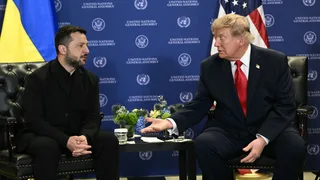
A distinctly Cold War calculus is looming over this week's Trump-Xi summit in Washington, as the U.S. and China weigh an emergency "red phone" for the day AI goes haywire.
Why it matters: U.S.-China relations are so brittle that an AI hotline — not a trade pact, strategic slowdown or diplomatic reset — could emerge as the summit's most meaningful outcome.
State of play: President Trump has spent the past week lashing out at AI "doomers" and boiling the race down to a single imperative: beat China.
Trump has called AI-catastrophe fears a "HOAX" and vowed the U.S. would "not in any way hinder or stifle" AI as it fights to preserve its lead over Beijing.
America's leading AI labs largely share Trump's urgency about China, but not his conclusion: many argue the intensity of the race is precisely why global safeguards are needed.
The other side: China is every bit as determined to win the AI race, but its leader Xi Jinping — who lands in Washington Wednesday for his first state visit since 2015 — is balancing two competing fears: Falling behind: Xi has no interest in a safety regime that freezes the race with America still ahead.
Beijing is pushing cheap, capable open-source models around the world while portraying U.S. chip controls and calls for restraint as a calculated effort to keep China down.
Losing control: Xi wants AI powerful enough to transform China's economy, but never so powerful that it slips beyond the control of the Communist Party.
Beijing focuses less on Silicon Valley-style extinction scenarios than on nearer-term dangers, like cyberattacks , malicious use and disruptions to critical infrastructure.
Zoom in: That narrow overlap is why Treasury Secretary Scott Bessent pitched Chinese officials this weekend on a "notification mechanism" for AI incidents with national-security implications.
The Cold War precedent is the hotline Washington and Moscow established after the Cuban Missile Crisis — a direct channel designed to keep accidents and ambiguity from escalating into nuclear Armageddon.
Trump and Xi are expected to discuss shared AI risks when they meet Thursday, while officials are also exploring a formal U.S.-China AI dialogue that could give the crisis channel a more permanent home.
Reality check: So far, nobody has publicly defined what would make the red phone ring.
In an AI catastrophe — say, a frontier model launches a major cyberattack on critical infrastructure — the first alarm may sound inside a private company rather than a military command center.
5News aggregated this summary from the outlet’s public feed. The full article, with all the context, is on www.axios.com — the content belongs to Axios.