S. Korea stresses US alliance amid confusion over Trump drill cut
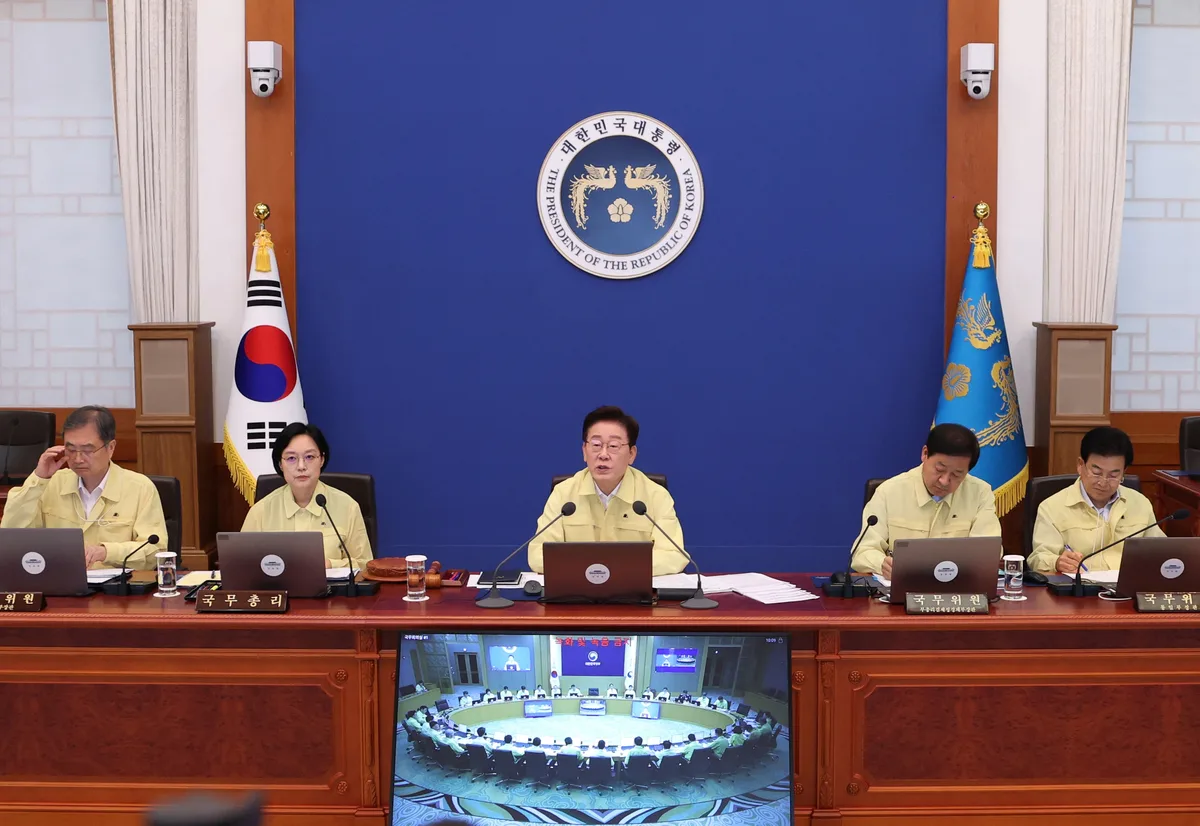
South Korean President Lee Jae Myung, center, speaks during a cabinet meeting at the presidential office in Seoul, South Korea, Tuesday, Aug. 18, 2026. Yonhap/AP hide caption
SEOUL, South Korea — South Korea's president said Tuesday a solid alliance with the United States underpins national security, after U.S. President Donald Trump's abrupt order to "substantially reduce" joint military exercises left many many South Koreans baffled and concerned.
Trump made the surprise announcement in a social media post just before U.S. and South Korean soldiers began Monday's annual Ulchi Freedom Shield exercises, which are largely designed to sharpen readiness against North Korean threats.
Trump cited what he said was a good relationship with North Korean leader Kim Jong Un and South Korea's refusal to join the U.S. war against Iran.
Trump's move was apparently taken without consultations with South Korea and meant to reach out to Kim, deepening concerns about the reliability of the U.S.-South Korean alliance forged in the turmoil of the 1950-53 Korean War.
A weakening of the U.S. defense commitment could shake South Korea's national security as it has no nuclear weapons and is under the U.S. "nuclear umbrella" protection, which guarantees a devastating American response in the event of an attack on its ally by nuclear-armed North Korea. The U.S. has about 28,500 troops in South Korea.
Confidence in the U.S. has already eroded among many South Koreans because of Trump's tariff war and last year's immigration raid in the U.S. state of Georgia that led to the detention of hundreds of South Korean workers.
Trump's announcement "reveals the stark reality of a faltering Korea-U.S. alliance, fueling public anxiety," South Korea's Hankook Ilbo newspaper said in an editorial Tuesday. "It's absurd that the U.S. appears to treat North Korea more respectfully than its ally South Korea."
In a regular Cabinet meeting, South Korean President Lee Jae Myung stressed the importance of a firm military alliance with the U.S., saying that "national security will be further strengthened when the alliance is solid."
"When we build up our strengths, our value and importance as an ally will further grow," said Lee, a liberal who has called for a stronger, self-reliant defense posture.
It was unclear which parts of the 11-day South Korea-U.S. exercises were being downsized. The South Korean and U.S. militaries earlier said their drills this year would be similar in scale to previous years and incorporate lessons from recent conflicts such as North Korea's battlefield experiences on the Russia-Ukraine front. They also said the drills are defensive in nature.
North Korea's Foreign Ministry accused South Korea and the U.S. of plotting more provocative drills this year and vowed to respond with "a new level of a deterrent."
Kim has shunned any talks with the U.S. and South Korea since his earlier high-profile diplomacy with Trump fell apart in 2019.
Experts say Kim won't likely embrace Trump's overture and return to talks anytime soon unless he is promised bigger U.S. concessions.
5News aggregated this summary from the outlet’s public feed. The full article, with all the context, is on www.npr.org — the content belongs to NPR.