3D map reveals cities of galaxies taking shape in early universe
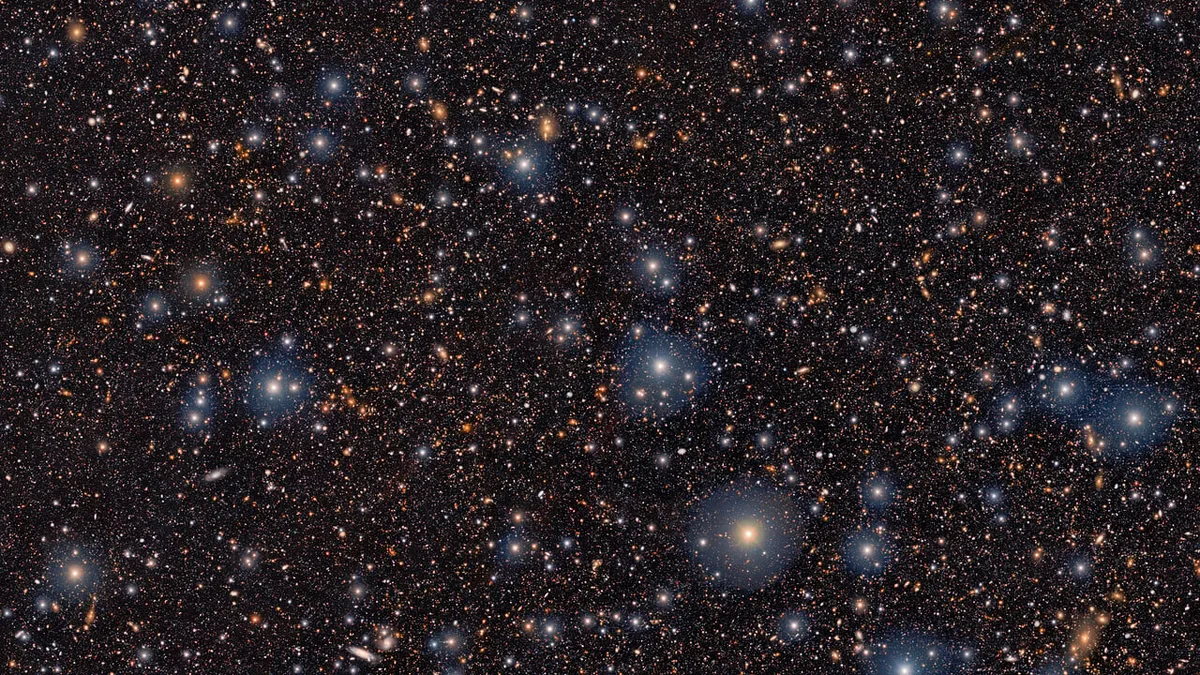
Astronomers have taken a patch of distant sky and turned it into a 3D map, revealing a colossal system with about 5,000 times more mass than the Milky Way in the early universe .
In previous space pictures, this area looked like a flat painted ceiling.
Galaxies appeared close together simply because they lined up from our point of view, even if some were separated by billions of light‑years in depth.
Because of that optical illusion, astronomers couldn't say for sure whether they were looking at one gigantic galaxy cluster under construction or a corridor where many clusters were in development.
The 3D map answered that.
By measuring how far away the galaxies are, scientists watched that view transform into a chain of clumps.
That new way of looking at the data showed this was not a construction zone for a regular galaxy cluster but a supercluster — a cluster of clusters.
Rather than one heap of galaxies, they were looking at cities of clusters.
"I think the distance and sheer scale of the structures we are studying is really extraordinary.
These are structures containing hundreds to thousands of galaxies," said Vandana Ramakrishnan, a graduate student at Purdue University in Indiana and lead author of the study, in a statement .
"It brings home the vastness of the cosmos." SEE ALSO: Small, icy worlds in the outer solar system barely changed since birth The main system mapped is called COSMOS‑Z3.1‑A, and it's the earliest supercluster ever found.
A second, smaller one, COSMOS‑Z3.1‑C, sits nearby in the same field.
Both are so distant that we see them as they were when the universe was only about 2 or 3 billion years old, less than a quarter of its current age.
Early surveys could only conclude that these were crowded locations for young galaxies.
5News aggregated this summary from the outlet’s public feed. The full article, with all the context, is on mashable.com — the content belongs to Mashable.