Astronaut captures mesmerizing auroras with iPhone from ISS | Space photo of the day for Oct. 13, 2026
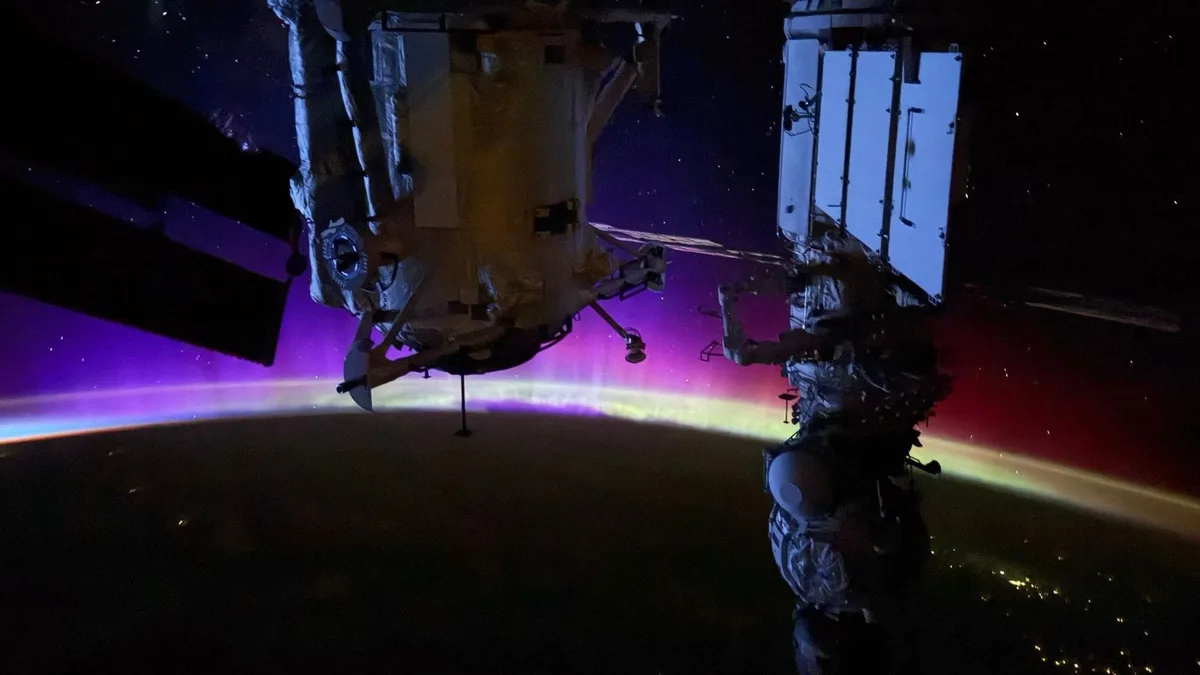
Earth's night side is wreathed in colorful auroras in a new smartphone image captured from the ISS. (Image credit: Anil Menon, NASA) NASA astronaut Anil Menon captured a gorgeous view of the northern lights dancing over the night side of Earth from the International Space Station on Oct.
10 using an iPhone camera.
What is it? Menon's photo reveals spectacular pink, purple and red auroras glowing in Earth's upper atmosphere above a sparse dappling of city lights, subtly blurred by the motion of the orbital spacecraft over the course of the exposure.
Bright stars glimmer between the solar panels and outer hulls of the ISS and visiting spacecraft, painted purple by the auroral display.
"Flying through is rare and amazing," Menon wrote in a separate aurora video he posted to X on Oct.
10.
"You can see the lights on the outside of [the] station reflecting back like Christmas LEDs.
It's definitely more immersive." Why is it amazing? Menon captured the auroras during a period of heightened geomagnetic activity, after several coronal mass ejections (CMEs) struck Earth's magnetic field, triggering geomagnetic storms ranging from minor (G1) to strong (G3) over the weekend.
During geomagnetic storms, more charged particles are accelerated along Earth's magnetic field lines toward the polar regions, where they collide with gases in the upper atmosphere; they excite them, causing them to release energy as light and producing spectacular auroral displays.
The blue-purple colors seen in Menon's image are largely produced by nitrogen at altitudes of around 60-120 miles (100-200 kilometers) , while the red hue comes from oxygen atoms higher up, typically above 125 miles (200 kilometers).
The photo is particularly impressive because it was captured on an iPhone camera, as opposed to the more traditional Nikon cameras that astronauts sometimes use to capture Earth during their time aboard the ISS.
Smartphone astrophotography has become increasingly popular over recent years, with some models now featuring bespoke modes for capturing the night sky. iPhones were even used by the astronauts of the Artemis 2 mission to document their historic flyby of the moon earlier this year! Interested in capturing your own images of the night sky using your mobile phone? Then be sure to check out our guide to photographing stars, the moon and the Milky Way with nothing but your smartphone camera.
5News aggregated this summary from the outlet’s public feed. The full article, with all the context, is on www.space.com — the content belongs to Space.com.