Is an AI kill switch a real thing?
As concerns about AI's capabilities reach a critical mass , California Gov.
Gavin Newsom is accelerating the state's plan to curb the development of the technology.
In a new executive order issued today (Sept.
18), Newsom calls for the creation of an expert-led panel tasked with "reinforcing and strengthening" the state's AI safety laws, including accelerating plans to enforce third-party safety evaluations and mandatory risk reporting.
SEE ALSO: Avian flu, drone swarms, and mass surveillance included in Anthropic's safety report The ordeer also directs the group to explore the possibility of an "emergency shut off" for frontier models, "otherwise known as an 'AI kill switch,'" Newsom said in a video posted to his X account, "which means a lot of things, depending on who you talk to." What is an AI kill switch? Newsom's correct.
The idea of a universal off button to stop increasingly powerful AI agents from "going rogue" has been percolating in legislative conversations and online discourse for the last year.
The term has become synonymous with a growing push for AI safety regulation, spearheaded in part by AI's own creators .
But what the kill switch would actually look like — specifically, the means through which it would halt AI en masse and who its chosen keeper would be — is still widely up for debate.
In July, two congressional representatives introduced the bipartisan AI Kill Switch Act , which would give the Department of Homeland Security (DHS) authority to slow down or halt an AI system deemed capable of causing "catastrophic harm." The bill would also require developers to institute mechanisms to "throttle, suspend, or fully shut down a covered AI system" — Newsom's order seeks to pass a similar mandate.
While not required under U.S. law, most individual AI labs have their own means to halt rogue systems, governed by humans and the company's own safety structures and alignment teams.
Some proposals for the development of "kill switches" simply urge labs to have these processes evaluated by external safety auditors.
Others seek to institute industry safety standards that would mandate emergency shut-offs, governed by the federal government.
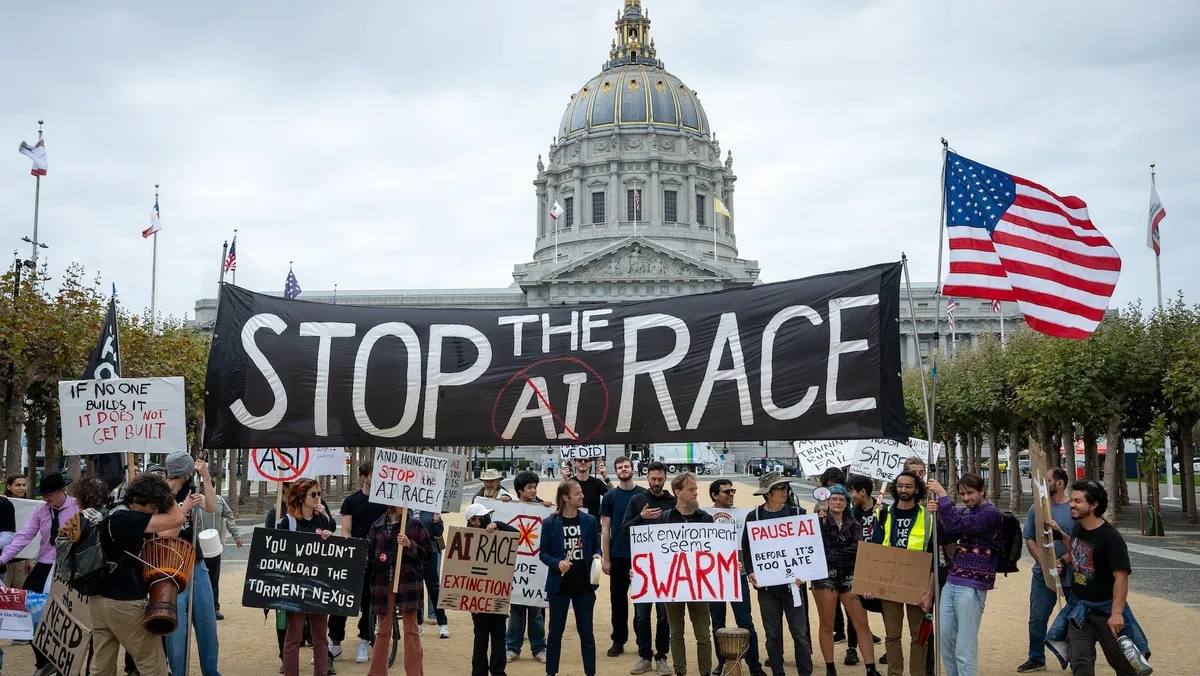
An increasingly vocal group of doomsdayers demands a sweeping fail-safe for all AI.
In an interview with Scientific American , Mark Nitzberg, executive director of the University of California, Berkeley, Center for Human-Compatible AI, called a universal AI kill switch "more of an aspiration than a reality.” Computer scientist Geoffrey Hinton, AKA the "Godfather of AI," told CNN he didn't think a kill switch would be an effective longterm solution for those who fear AI superintelligence.
5News aggregated this summary from the outlet’s public feed. The full article, with all the context, is on mashable.com — the content belongs to Mashable.