Scientists just found the fastest known star in the Milky Way. It zooms around our black hole at 15,500 miles per second
Astronomers have found the fastest known star in the Milky Way, a faint object racing around Sagittarius A*, the supermassive black hole at the heart of our galaxy.
Dubbed S301, the star reaches about 15,500 miles (25,000 kilometers) per second at its fastest — more than 8% the speed of light.
"What is special about this star is that it's orbiting Sagittarius A* on a very tight orbit, taking just 8.7 years to complete it, and is approaching the black hole at a mere 12 times the distance of Earth to the sun .
That is unprecedented," study author Felix Mang, a Ph.D. student at the Max Planck Institute for Extraterrestrial Physics in Germany, said in a statement .
The discovery gives astronomers a new way to probe the roughly 4.3-million-solar-mass black hole.
General relativity predicts that a rotating black hole drags spacetime along with it, an effect known as frame dragging, or Lense-Thirring precession.
That distortion should gradually alter S301's orbit — because the star ventures so close to Sagittarius A*, those changes may become measurable within about a decade.
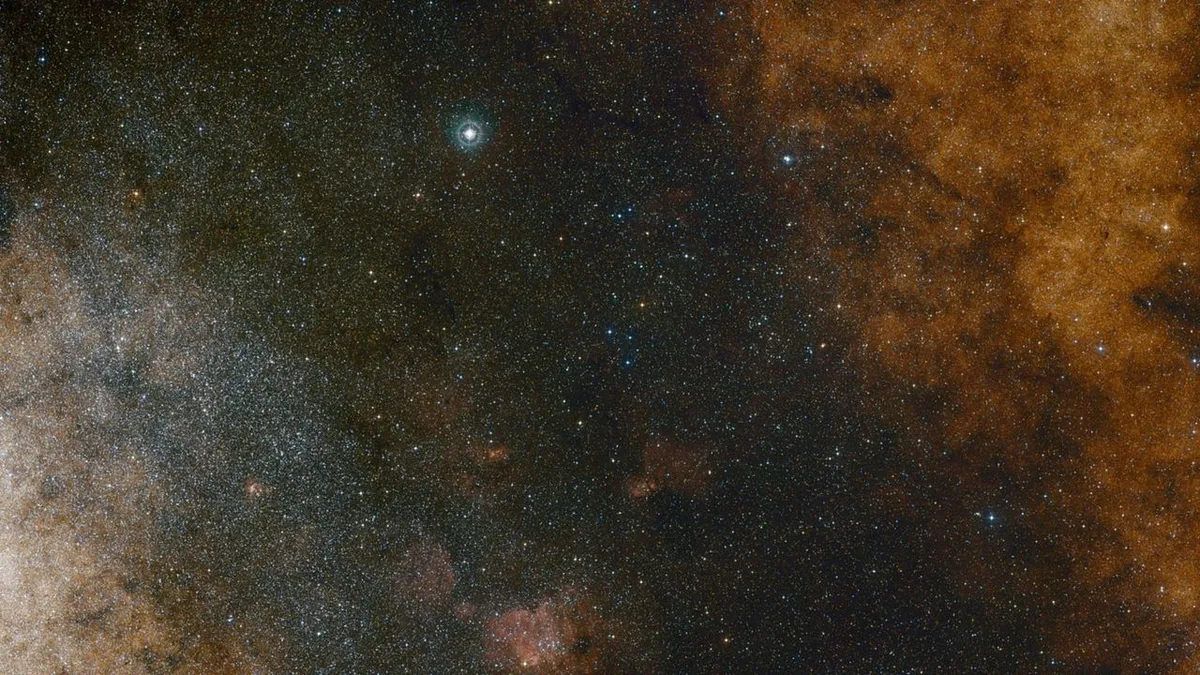
This visible light wide-field view shows the rich star clouds in the constellation of Sagittarius (the Archer) in the direction of the center of our Milky Way galaxy.
The entire image is filled with vast numbers of stars — but far more remain hidden behind clouds of dust and are only revealed in infrared images.
This view was created from photographs in red and blue light and form part of the Digitized Sky Survey 2. (Image credit: ESO and Digitized Sky Survey 2.
Acknowledgment: Davide De Martin and S.
Guisard) For the first time, we would actually be able to measure very directly the spin of a massive black hole, which would be a key test of Einstein's theory," said study co-author Stefan Gillessen, also of the Max Planck Institute.
This sequence of images, taken with the GRAVITY instrument at ESO’s Very Large Telescope Interferometer (VLTI), show several stars orbiting Sagittarius A*, the supermassive black hole at the centre of our galaxy.
One of these stars, known as S301, was recently found to pass much closer to the black hole than any other known star. (Image credit: ESO/GRAVITY collaboration) Researchers spotted S301 in 2023 using the GRAVITY instrument on the European Southern Observatory's Very Large Telescope Interferometer in Chile, then traced it back through observations from 2021 and 2017.
5News aggregated this summary from the outlet’s public feed. The full article, with all the context, is on www.space.com — the content belongs to Space.com.