How an ancient collision with another galaxy transformed the Milky Way
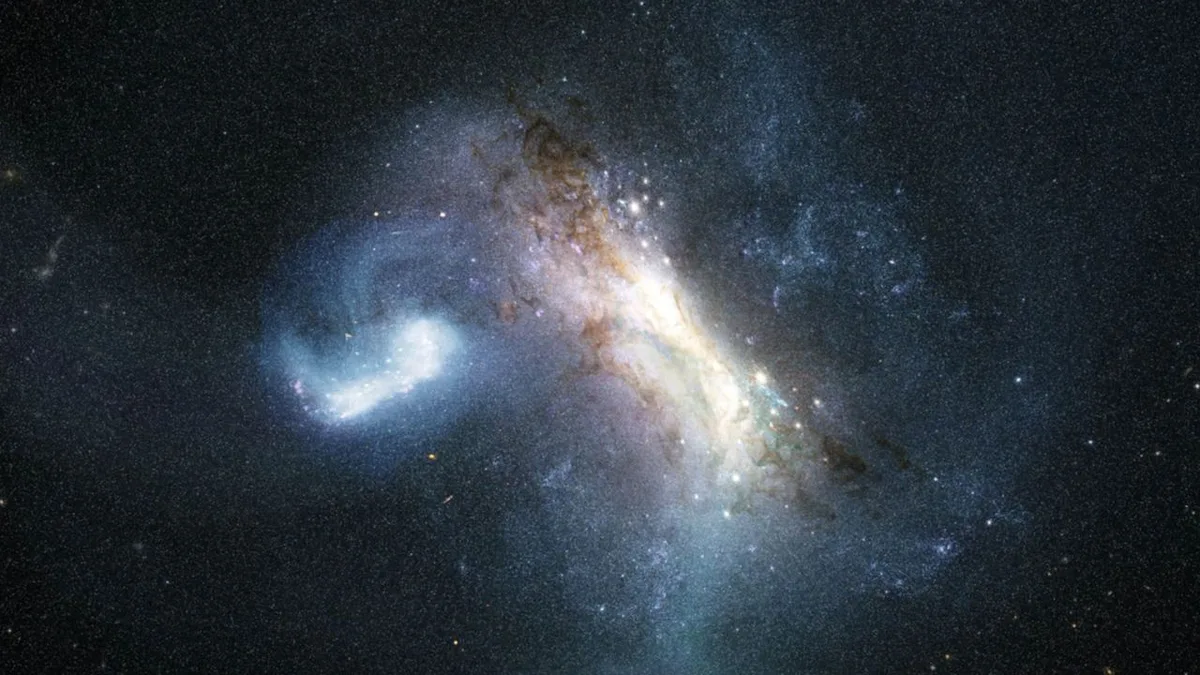
The Hubble Space Telescope has discovered evidence that our galaxy experienced a significant collision and merger with a dwarf galaxy 11.8 billion years ago.
Mergers between galaxies are one of the main ways in which galaxies can grow.
However, while we can witness mergers taking place in other galaxies, figuring out our Milky Way galaxy's history requires painstaking detective work.
Even now, the story is only partly known.
"Our home is the Milky Way galaxy, but we do not know how our house was built," Davide Massari of the Astrophysics and Space Science Observatory of Bologna in Italy said in a statement .
Massari is lead author of a paper describing the discovery of an ancient galactic merger.
"In this paper we discover where the first significant batch of bricks came from: a dwarf galaxy that we call LKH." LKH stands for Low-energy–Kraken–Heracles, which is an obtuse reference to three earlier research papers that tangled with the idea of mergers early in our galaxy's history.
In recent years, one other significant merger has come to light, which is a collision with a galaxy referred to as the Gaia–Sausage–Enceladus (GSE) galaxy about 10 billion years ago.
The GSE had its own family of globular star clusters that became integrated with the Milky Way's own globular clusters during the collision.
Now, Massari's team have discovered a third population of globular clusters that do not seem to be native to the Milky Way, nor to have belonged to the GSE galaxy.
Instead, they seem to have arrived 11.8 billion years ago, which is before the GSE merger.
"Thanks to the high resolution and depth of Hubble imaging, we could measure the age and the metal content of these clusters with unprecedented precision," said astronomer Chiara Zerbinati of the University of Bologna, who is a co-author on the paper.
Metals are astronomer-speak for elements heavier than the hydrogen and helium that formed in the Big Bang , so they include the likes of oxygen and carbon as well as iron and aluminum.
"Coupled with measurements from [the European Space Agency mission] Gaia , this made it possible to distinguish a population of globular clusters that are different from the others," said Zerbinati.
5News aggregated this summary from the outlet’s public feed. The full article, with all the context, is on www.space.com — the content belongs to Space.com.