Kids with brain injuries thrive at this camp. But federal research funding is in flux
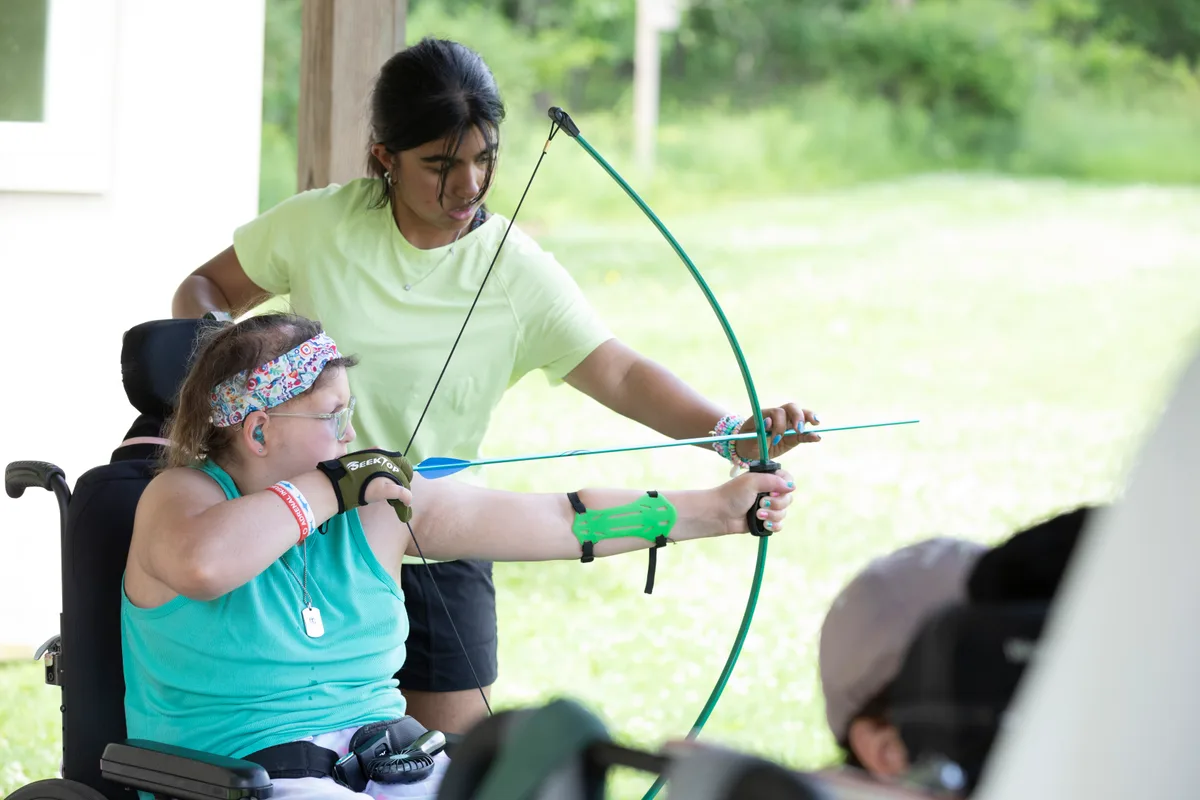
Camp Cranium counselor Anvitha Tharra (right) helps participant Angelica Zander learn to use a bow and arrow. The weeklong event in Pennsylvania's Columbia County provides community, support and fun for children with brain injuries. Sarah Hofius Hall/WVIA News hide caption
In an open field, arrows whizzed through the humid June air and struck their targets. Campers and counselors cheered.
It was archery hour at Camp Cranium in Millville, Pennsylvania. Operations director Drew Meyer watched, a few tears escaping from behind his dark sunglasses.
"They will surprise you, like, flat out," he said of the campers, who have all survived brain injuries. "They'll come out here, and they'll shoot for three hours and start hitting the target."
Campers, ranging in age from 10 to 21, have been coming to Camp Cranium in Pennsylvania's rural Columbia County since 2008. Some of their brain injuries are so severe that they have to relearn basics, from talking to tying their shoelaces. Some use wheelchairs or crutches. But during a week at camp, they climb rock walls, swim and whiz down a zip line through the lush forest.
Shots - Health News Meet the 'glass-half-full girl' whose brain rewired after losing a hemisphere The existence of Camp Cranium, as well as a handful of others like it, is a response to a decades-long national trend: More people, including children, now survive crises resulting in brain injury than they did in the 1980s. The improvements in survival are largely due to seat belt laws and federal investments in research and trauma centers that can treat injuries quickly.
But recently, efforts to track and prevent one type of brain injury — traumatic ones — are in flux after Congress didn't renew a law to further research and prevention of traumatic brain injuries, and the Trump administration fired hundreds of employees at the Centers for Disease Control and Prevention (CDC), including the team tracking traumatic brain injuries, or TBIs.
Christopher Currid climbs the rock wall at Camp Cranium. Sarah Hofius Hall/WVIA News hide caption
"Brain injury can happen to anybody," said Rebeccah Wolfkiel , executive director of the National Association of State Head Injury Administrators . "This community deserves more."
Lucas Hardy, 14, smiled at the encouraging crowd below. In a shady clearing in the woods, he climbed the 30-foot rock wall, aided by a hoist that pulled him out of his wheelchair and helped support his moves. Hardy suffered a traumatic brain injury at age 3, when a tree branch fell on him at a birthday party.
Annually, an estimated 2.8 million Americans experience a TBI, including about 475,000 children, according to the Brain Injury Association of America .
Recent data suggests those numbers are undercounts. In 2018, a CDC team piloted a household survey asking about TBIs in a sample of U.S. children and adults. The results informed a study concluding that such injuries, which are often considered "hidden" because the damage is internal and unseen, are more widespread than hospitalization numbers suggest.
Brianna Engleman (right) collects song requests for a dance scheduled that night at Camp Cranium.
5News aggregated this summary from the outlet’s public feed. The full article, with all the context, is on www.npr.org — the content belongs to NPR.