Planetary genealogy: Milky Way worlds belong to 1 of 2 ‘families,’ scientists find
You can tell a lot about how a child will age by looking at their parents, and it turns out that this could be true for planetary systems, too.
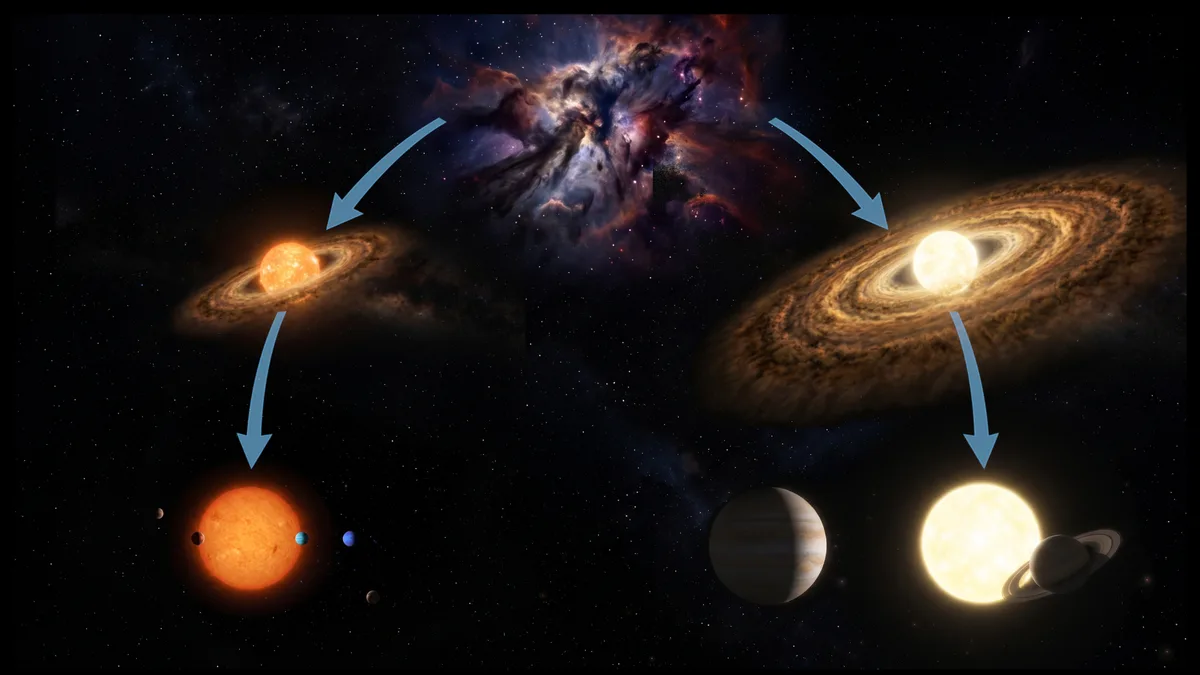
Scientists have performed cosmic genealogy on planetary systems in the Milky Way, finding two distinct families that influence the evolution and fate of these systems.
The study team, led by researchers at the Italian National Institute for Astrophysics (INAF), studied 300 of the best-understood multiplanet systems of the over 1,000 that astronomers have discovered in the Milky Way.
The team's research clarifies how the environments around infant stars directly affect planetary fates and, in turn, the survival of extrasolar planets, or exoplanets , that are potentially capable of hosting life.
That could be crucial as astronomers search for life beyond the solar system , pointing them to systems with potentially habitable planets like Earth.
"The fundamental question we started from was: What determines the characteristics of planetary systems as we see them today? Are they established at birth or sculpted by evolution over time? The truth, in the end, turned out to lie somewhere in the middle," team member and INAF researcher Diego Turrini said in a statement sent to Space.com.
"Our results show that there is a genetic link between planetary systems and their stars, and that, depending on the star around which they are born, this link also determines their fate," Turrini added.
What is the genetic code of a planetary system? The first "family" the scientists identified consists of wide, massive systems, often with total masses between two and 10 times that of our own solar system.
The planets in these systems orbit stars more massive than the sun with lower concentrations of elements heavier than hydrogen and helium (which astronomers somewhat confusingly call metals) than seen in our star.
The second family is more compact and lower-mass systems.
The members of this family are composed of planets with comparable masses and sizes, a so-called "peas-in-a-pod" configuration.
They orbit stars with mass and metallicity equal to or lower than those of the sun, with orbits that are usually much tighter than those of Mercury , the closest planet to the sun.
One of the "genes" Turrini and colleagues selected to sort planetary systems into families was the deviations that planets make from orbiting their star in the same circular plane.
That, in turn, reveals a family history of violent gravitational instability caused by events like giant collisions and planetary ejections.
5News aggregated this summary from the outlet’s public feed. The full article, with all the context, is on www.space.com — the content belongs to Space.com.