Slate Commenters Have Been Trolling Me for Years. I Decided to Confront Them—and Was Startled by What I Found.
Sign up for the Slatest to get the most insightful analysis, criticism, and advice out there, delivered to your inbox daily.
I’ve been a journalist for long enough to be familiar with most of the job’s occupational hazards. I’ve angered powerful people without a legal canopy to protect me. My cursor has hesitated over the Send buttons of emails containing invasive questions. I know what it’s like to be chewed out, to have your confidence flattened, to junk entire drafts and start over from scratch. And yet, for most of my career, I never did attract a personal troll.
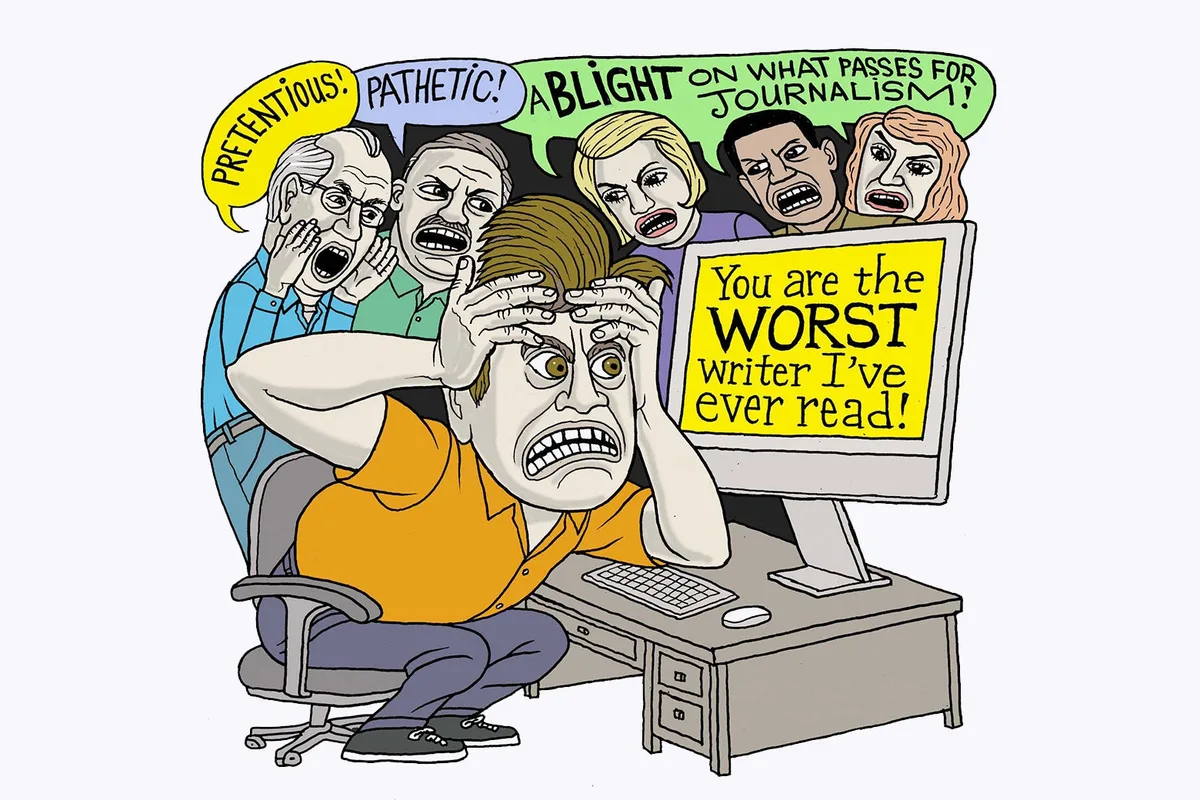
In this line of work, having a troll is the opposite of having a fan. It’s someone out there—across the astral span of the internet—who has decided to keep tabs on what you publish with the singular intent of mocking everything you write. Since I never had one, I wondered if people like this had gone extinct alongside the rest of the web I used to know. After all, digital media, and its trademark pugnacious tone, is basically defunct. The linear rapport necessary for a blogger to become someone’s nemesis simply no longer applies; the written word is on life support. At least, that’s what I thought—until I discovered the Slate comments section. At last, I had finally found my haters.
Slate’s comments section is not prominently advertised on the homepage, and when I was hired as a staff writer in the spring of 2023, I didn’t know it existed. But, sure enough, all of the articles on the website are studded with a button shaped like a speech bubble. Click on it, and a discussion thread quietly materializes at the bottom of the screen, revealing one of the last few remaining active commenting communities hosted by a magazine. The section possesses a distinctly Web 1.0 architecture: There are no reaction GIFs or YouTube embeds, and posters tend to distinguish themselves with multisyllabic usernames. Trawling through the comments feels a little bit like exploring the sediment of cyberspace. As such, the core clientele—about 200 strong—is composed of people who have been visiting Slate for a very, very long time. They are some of our most dedicated readers. They’ve also despised pretty much everything I’ve ever written.
Comments sections are, by nature, snarky. The format was devised to be a digital version of the newspaper’s good old-fashioned Letters to the Editor page—itself a receptacle for readers to loudly hector the opinion columnists they found annoying. Once considered default features, many of those sections disappeared as digital media matured, mostly because editors determined them to be hotbeds of inanity and harassment. (Recently they’ve made something of a comeback—earlier this year, the Atlantic reintroduced a comments board after abolishing it in 2018.) But Slate’s comments section has survived, and it has retained its characteristically adversarial register to this day. The threads bloom with treatise-length complaints, exasperating grammatical pedantry, and the usual flame-war material.
5News aggregated this summary from the outlet’s public feed. The full article, with all the context, is on slate.com — the content belongs to Slate.