LOCAL VEHICLE PRODUCTION: Minister of Small Business Development Ndabeni pushes for localised manufacturing in automotive sector
Minister Stella Ndabeni calls for reliable infrastructure and competitive local manufacturing while imported vehicles gain ground and automotive suppliers struggle with power disruptions.
Minister of Small Business Development Stella Ndabeni says the environment in which the automotive industry operates plays a critical role in the success of small and medium-sized enterprises (SEMs) facing mounting pressure caused by the country’s economic downturn.
Ndabeni said production in motor vehicles, parts and accessories and other transport equipment declined by 2.5% in 2025 compared with 2024.
Equally, the industry contributed about 5.2% to South Africa’s gross domestic product (GDP) in 2025, comprising 3.3% from manufacturing and 1.9% from automotive-related retail, she said.
“The evidence gives us an important message that automotive remains one of the country’s most significant industrial sectors, but its contribution cannot be taken for granted.”
This was why it was important that the space the businesses operated from remained conducive, said Ndabeni.
“This means electricity supply has to be sustained at all times,” she said, so that small businesses didn’t waste money on securing services that should be provided by local government, and instead could focus on production to preserve jobs.
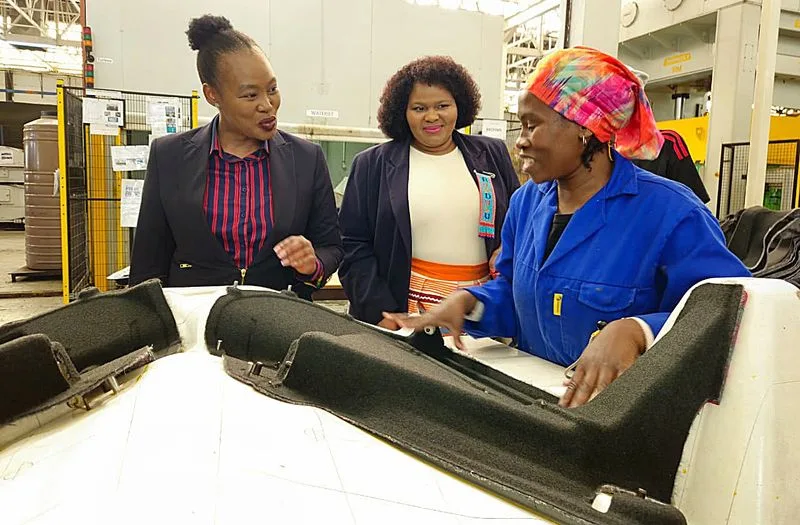
Ndabeni was speaking on Tuesday at SME Acoustex, an automotive supplier in Neave Industrial Park, where she conducted an oversight visit ahead of a breakfast with industry roleplayers at the Boardwalk Hotel and Convention Centre.
Acoustex is a Tier 1 automotive company that produces the boot package components for the VW Polo, which are exported worldwide. It also produces seat covers for the Ford Ranger.
When the Automotive Masterplan was developed, Ndabeni said South Africa accounted for about 0.68% of global vehicle production.
“The Automotive Masterplan established an ambition of increasing local content from approximately 39% to 60%. The Masterplan explicitly recognises that achieving localisation requires the development of domestic component manufacturing throughout the automotive value chain. The localisation challenge is visible in the domestic market. Imported light vehicles accounted for 69.1% of total domestic light-vehicle sales in 2025, compared with 62.7% in 2024,” the minister said.
She said this did not mean that everything currently imported should be manufactured locally, but it raised an important question: what could realistically and competitively be manufactured in South Africa and which components and materials could be localised?
“We need industry to tell us what is required in terms of technology, machinery, tooling, certification, skills, working capital and long-term off-take. That is the level of specificity we need from this consultation.”
After the Covid-19 pandemic, Acoustex was among the city’s automotive SMEs that were affected when production levels significantly declined, threatening jobs, while it still had to deal with a huge electricity bill from the Nelson Mandela Bay metro.
5News aggregated this summary from the outlet’s public feed. The full article, with all the context, is on www.dailymaverick.co.za — the content belongs to Daily Maverick.