When Enemies Become Allies: Ethiopia's Fragile Coalition Against Abiy
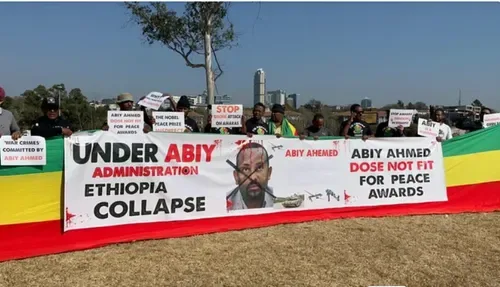
Members of the All United Amhara Association in South Africa picketing in Innesfree Park in Sandton, before the start of the BRICS summit at the Sandton Convention Centre
Fano fought alongside federal forces against the TPLF during the Tigray war, a conflict that killed up to 600,000 people and left deep scars of ethnic violence on both sides. That war ended with the 2022 Pretoria Agreement, under which the TPLF was meant to demobilise. It never fully did, and Reuters reported that fighting had already broken out again along the Tigray border months before this alliance was announced. TPLF Vice President Amanuel Assefa says the two former enemies had actually been talking for over a year before going public, which tells you the current break with Addis Ababa didn't happen overnight. It was built slowly, out of shared grievance rather than shared history.
That grievance is the coalition's real glue. Fano rose up against the federal government in 2023 after refusing orders to disarm and has fought a bloody insurgency in Amhara ever since. The Oromo Liberation Army has been at war with the state since 2018. Add smaller groups from Afar, Benishangul-Gumuz and the Somali region, and you have representation from roughly half of Ethiopia's regional states, all accusing Abiy's government of what their joint statement calls war, genocide and the risk of national disintegration.
History offers a useful comparison here. Libya's post-Gaddafi factions and Syria's fractured opposition both discovered that unity against a common enemy rarely survives contact with victory, because the disputes that divided them were never resolved, only postponed. Ethiopia's new alliance carries the same structural weakness. Fano and Oromo political forces hold sharply different visions on ethnic federalism and territorial administration. Tigrayan and Amhara forces still dispute control of Western Tigray, a flashpoint that helped ignite the original war and has not gone away simply because both sides now share an enemy. TPLF spokesman Michael Asgedom's admission that joint military operations "may become necessary" suggests political cooperation alone may not hold the coalition together for long.
Abiy's spokesperson Billene Seyoum has accused the alliance of receiving Eritrean financial backing, a claim Asmara denies but one that fits an established pattern. Eritrea and the TPLF have been bitter adversaries since the 1998 to 2000 border war, yet reports of a tactical understanding between Asmara and elements of the TPLF have circulated for months, driven less by affection than by mutual alarm at Abiy's ambitions toward the Red Sea port of Assab. If Eritrea is quietly backing a coalition that includes its former enemy, it says less about reconciliation and more about how thoroughly Abiy has managed to alienate everyone around him at once.
Abiy's advisers have dismissed the alliance as capable of causing chaos but not of toppling the government, and Ethiopia's military remains far larger and better resourced than any single faction here.
5News aggregated this summary from the outlet’s public feed. The full article, with all the context, is on iol.co.za — the content belongs to IOL.