Nzimande confirms waste innovation roadmap was 'severely underfunded'
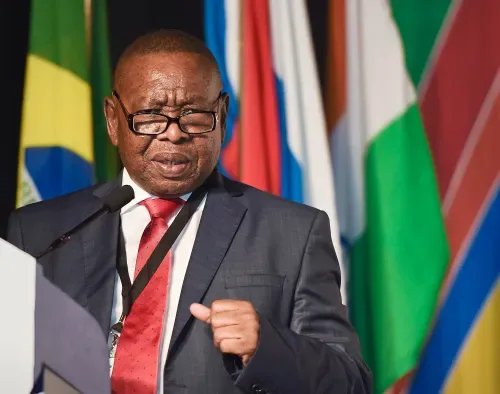
Science, Technology and Innovation Minister Blade Nzimande has confirmed that the waste research, development and innovation (Waste RDI) initiative faced funding shortfall after it only received just a portion of the original R3.9 billion funding.
Responding to parliamentary questions from MK Party MP Thembinkosi Mjadu, Nzimande said an independent evaluation was conducted to assess whether the Waste RDI Roadmap managed to meet its intended outcomes between 2015 and 2024.
“The evaluation revealed that, while the Waste RDI Roadmap was conceptually sound and strategically aligned with national waste priorities, it was severely underfunded, receiving only 3.2% of the targeted R3.9 billion budget over ten years.
“This funding constraint meant the programme functioned as seed funding rather than a comprehensive innovation initiative,” he said.
Nzimande elaborated, noting that despite the funding limitations, the programme saw researchers manage to leverage over R102 million in additional resources.
“This leveraging success also demonstrates the Waste RDI Roadmap’s effectiveness in transforming initial proof-of-concept projects into more extensive initiatives capable of progressing towards implementation phases.
Nzimande emphasised that the R3.9 billion funding request was, from the outset, an aspirational budget based on ambitions.
“The reduced funding had more of an impact on the scale of activities, rather than excluding a ctivities.”
According to Nzimande, the Waste RDI Roadmap has not only improved the infrastructure and capabilities within South Africa's National System of Innovation but has also bolstered research efforts across 17 institutions.
It successfully addressed various waste management challenges through nine strategic grant calls, resulting in over 50 research projects.
These initiatives cover diverse areas, including electronic waste and marine plastic debris.
The Waste RDI Roadmap has reportedly achieved groundbreaking technology transfer outcomes.
Innovative projects have emerged, such as systems for collecting disposable diapers in low-income regions, biogas systems implemented in rural schools, and specialised waste management tools designed for various applications, including brick-making.
Nzimande said the department has introduced the Circular Economy Science Technology and Innovation Strategy that is expected to respond to global, regional and local shifts in science, technology and innovation needs and priorities.
5News aggregated this summary from the outlet’s public feed. The full article, with all the context, is on iol.co.za — the content belongs to IOL.